
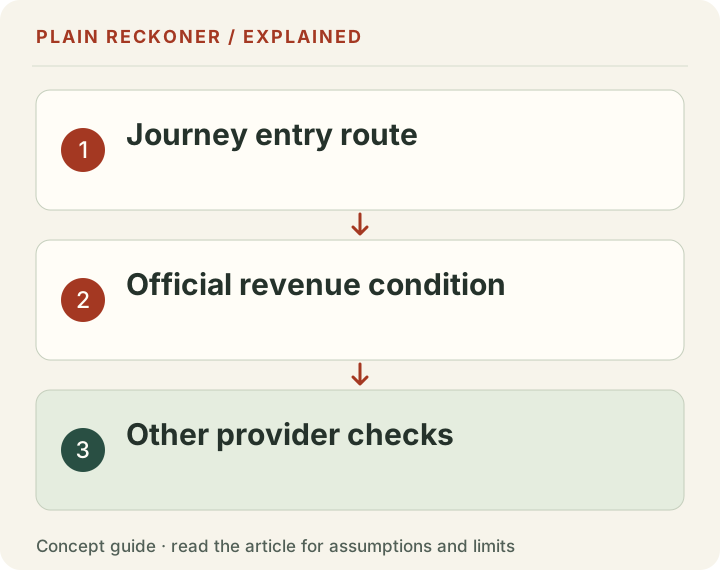
Journey and Mediavine Official use different entry measures. Journey counts a qualifying session population over 30 days; Official lists an annual advertising-revenue requirement. A pageview forecast cannot certify either application.
The current Mediavine application requirements list $5,000 in annual advertising revenue for Official. Journey’s help page specifies 1,000 premium sessions in 30 days. Read which sessions count before comparing that minimum with total worldwide visits.
What the provider pages say on 24 October 2026
The current Mediavine application page states the annual ad-revenue minimum and other quality conditions. In its Journey section it describes sessions from Tier 1 countries. Journey's dedicated minimum-requirements help page uses the term premium sessions. These are two current provider descriptions; do not replace either with the unsupported claim that any 1,000 worldwide sessions qualify.
The Journey help page also describes connecting GA4 and a review of content and audience quality. It lists situations that can disqualify a site. Read that page for the current conditions rather than treating a comparison table on any independent site, including ours, as the application contract. Requirements and operating processes can change.
If your dashboard count does not clearly map to the qualifying population, ask the provider which report it uses. A geography filter may help you inspect your audience, but we cannot certify that a hand-built filter reproduces all of a provider's qualification rules. A site can meet a headline number while other review questions remain open.
This is the reason our network checker leaves unknown information unknown. It screens published conditions using the inputs you supply. It does not issue an acceptance decision or pretend to see the data inside a provider account.
What $5,000 means in a hypothetical steady year
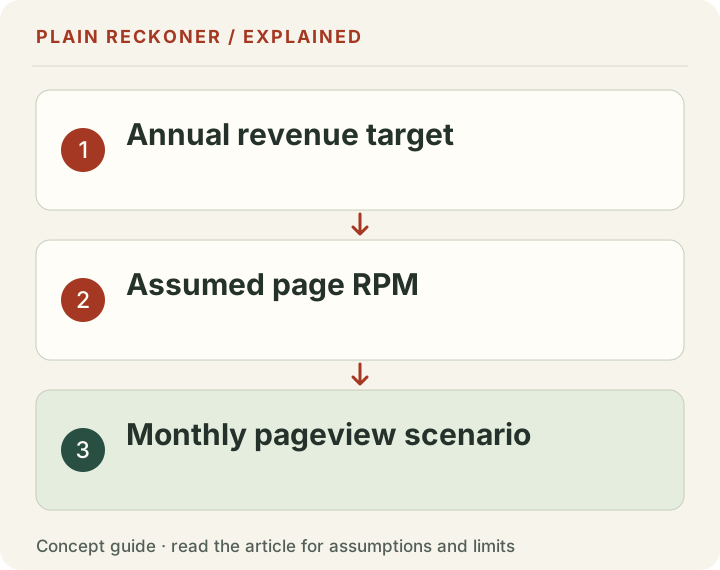
Dividing $5,000 by twelve gives about $416.67 a month. If a site earned a constant page RPM, the traffic calculation would be:
monthly pageviews = round up(($5,000 / 12) / page RPM × 1,000)
Our historical page-RPM dataset contains 123 display-only businesses with broker-verified traffic and revenue. At its median of $15.21, the calculation yields 27,395 monthly pageviews. The previous version rounded that target down to 27,394; a minimum income target should round upward.
| Historical sample RPM used as a scenario | Monthly pageview target |
|---|---|
| $2.21, pooled 10th percentile | 188,537 |
| $15.21, pooled median | 27,395 |
| $35.05, pooled 90th percentile | 11,888 |
These are not Mediavine-specific RPMs, expected results for a new site, or a substitute for the advertising revenue actually earned in the provider’s applicable reporting period. Do not annualize one month and present the result as an already-earned annual total.
How the niche assumptions change the arithmetic
The next table uses historical niche medians. Some rows contain very small samples, so the differences cannot establish that changing subject causes a particular income result.
| Historical niche median | Page RPM | Monthly pageviews for the scenario |
|---|---|---|
| Finance | $29.73 | 14,016 |
| Home & Garden | $25.43 | 16,385 |
| Culinary | $20.59 | 20,237 |
| Pet care | $18.97 | 21,965 |
| News & education | $18.13 | 22,983 |
| Food & drink | $17.93 | 23,239 |
| Technology | $15.51 | 26,865 |
| Information & databases | $8.41 | 49,545 |
| Entertainment | $8.41 | 49,545 |
| Religion & spirituality | $8.07 | 51,632 |
| Hobbies | $7.07 | 58,935 |
| Gaming | $6.48 | 64,301 |
The finance and gaming rows differ by about 4.6 times in this arithmetic. That is a comparison of sampled medians, not proof that subject determines your RPM. Geography, traffic source, ad implementation, reporting periods and the sale-selected sample can all matter.
Use your own numbers when you have them
Divide revenue by pageviews for the same complete period, then multiply by 1,000. The RPM tool compares that figure with the cross-niche distribution of site-level RPMs. It does not calculate a within-niche percentile; the previous article incorrectly said it did.
Keep sessions and pageviews separate. Use session RPM versus page RPM to understand the denominator, and check monetized RPM if the provider changed the traffic population used in its dashboard. If your ads just launched, inspect the reporting window before treating an early average as a forecast.
The real business story behind the application question
Journey's own introduction to the service describes an early-stage route for publishers, rather than a guarantee that a particular traffic count will produce a particular income. Its page also features Lillie Marshall of Drawings Of..., discussing monetizing a site built around her art and writing. That is a provider-selected testimonial. It is evidence of how Journey presents its product, not an independently audited earnings result.
The useful part of the story is the business sequence. First there is a publication and a reason for people to read it. Then comes the question of whether its audience and content fit advertising. Revenue is a further outcome, after implementation and actual advertiser demand. Starting with an RPM target and working backward does not remove those earlier requirements.
This matters for a small publisher deciding where to spend the next week. A calculator may show an attractive income scenario, but it cannot create original articles, an engaged audience or clean traffic. Use the scenario to understand the size of the question. Use provider documents and your own complete reports to decide whether an application is ready.
We have not interviewed that publisher, accessed the business's accounts or verified the testimonial's outcomes. Naming the source and its limits is part of the story, rather than a footnote that turns a marketing example into independent research.
Build a small application worksheet
Use one row for each required measure. Write the exact metric name, the relevant reporting dates, the source report and whether the value is known. Separate actual earned advertising revenue from projections, sponsorship income, affiliate commissions and product sales unless the provider explicitly asks for a combined measure.
For traffic, keep pageviews, sessions and users in different rows. Google Analytics explains a session as a period of interaction; it is not a synonym for an individual page load. Your readers can open more than one page, and different tools may count traffic with different rules. A pageview total cannot be substituted just because it is the easiest number to find.
For annual revenue, retain the underlying reports and their covered period. Twelve months of matched actual earnings is different from multiplying a promising month by twelve. If the current application does not clearly explain the reporting window, request clarification rather than quietly choosing whichever interpretation makes the site appear to qualify.
Keep a final column for unresolved conditions: audience quality, account standing, content ownership, technical compatibility or any other provider-specific question. This column prevents a green numerical check from being mistaken for a completed application review. It also gives you a short, concrete list to send the provider.
A worked publisher example with two different answers
Suppose a publisher reports 20,000 monthly pageviews and $300 of monthly ad revenue. For that same month, page RPM is $15. The site also reports 12,000 total sessions, but it has not yet established how many qualify for Journey. Those numbers are chosen for this example; they are not a customer result.
The page RPM calculation is valid for the supplied month: $300 divided by 20,000, multiplied by 1,000. A hypothetical year of twelve identical months would produce $3,600. That is below $5,000, but the annualized scenario is still not a report of actual annual earnings. The publisher should inspect its actual applicable revenue period before making an application claim.
The Journey answer remains unresolved. Knowing there were 12,000 total sessions does not establish the qualifying count or the content review. It would be wrong for a calculator to infer acceptance from the larger number. Two independent questions can therefore produce one calculated revenue result and one unknown eligibility result.
Now suppose the publisher has earned $5,400 in the relevant annual period. That clears the published numerical revenue floor, assuming the provider accepts that revenue definition and period. It does not erase the other quality conditions. The next action is to assemble the evidence and follow the application process, not to treat the numerical pass as a guarantee.
Test an earnings range before planning around one RPM
A single benchmark can feel more certain than the evidence supports. Try several RPM assumptions and ask what would happen if the lower case were the one you received. At 20,000 monthly pageviews, a $10 page RPM gives $200 of monthly ad revenue; a $15 page RPM gives $300; a $20 page RPM gives $400. Those are scenarios under a fixed traffic assumption.
The difference can matter if you plan to pay for writers, software or another recurring cost. A budget that works only in the highest case is more exposed than one that works in the lower case. None of those RPM values is a promise from Mediavine or Journey, and this example does not estimate how likely each case is.
Keep traffic changes separate. If pageviews fall while RPM rises, total revenue can still decline. Conversely, more pageviews can mask a weaker revenue rate. The revenue-comparison tool separates the arithmetic, but the arithmetic alone cannot tell you whether a network change, audience shift or seasonal advertising demand caused the result.
A useful next step is to write down the decision that would change under each case. If every reasonable case leads to the same action, debating the exact benchmark may not be the best use of your time. If the cases change the decision, gather better evidence before committing to a fixed expense.
Compare a network move using contribution and timing
A higher reported RPM is not enough to establish that moving is worthwhile. Check whether both dashboards use the same traffic denominator, whether earnings are publisher-net, whether the periods match and whether there are fees or transition costs. Then compare the effect on the amount available after the costs you actually incur.
Some costs are paid once, while others recur. Keep a setup expense separate from a monthly subscription. Also keep earned revenue separate from the date the cash arrives. A business can show higher earnings while facing a short-term cash gap during a payment transition. Read the actual agreement before choosing a date to move.
Make the comparison reversible on paper first. Save the old assumptions, change one important input and inspect the difference. Test a traffic decline as well as an RPM increase. If the case works only while ignoring a plausible traffic change, the model is telling you that the decision depends on an unverified assumption.
Do not cancel an existing arrangement solely because a calculator shows a higher hypothetical number. Confirm eligibility, implementation requirements, contract restrictions and timing with the relevant providers. Our tools help make the questions visible; they cannot negotiate the terms or verify an acceptance inside a private account.
A practical next-week plan
Start by collecting the reports you already have. Use matching dates and write down the units. Recalculate your current RPM once, then compare it with the figure shown in your dashboard. Explain any difference before using the rate to set a target. Missing or mixed units are easier to fix now than after a network switch.
Next, read the current application pages and note the date you checked them. Save questions about ambiguous terms rather than treating uncertainty as a failed requirement or silently filling it in. If you are still below a numerical floor, identify which actual measure needs to change; more pageviews and more qualifying sessions are not the same target.
Then choose one reader-facing improvement you can evaluate. It might be a clearer article structure, a useful original example or a faster page. Do not buy traffic to manufacture eligibility, and do not add pages only to reach an article-count quota. A publisher needs readers who find the work useful, not a spreadsheet that looks ready for an application.
At the end of the week, review what you learned and what remains unknown. A specific question with the relevant report is more useful to a provider or a manual reviewer than a request to predict an RPM. If you ask us for a review, remove private reader details and account credentials; anonymized totals, date ranges and the decision you are considering are enough to start.
Application planning is a separate step
Review the current provider documentation and the reporting period it asks you to prove. Qualifying content, genuine traffic and review still matter after a number clears a minimum. For other options, see the current requirements comparison, including Raptive’s audience-share conditions and Ezoic’s account-specific exceptions.
Correction and limitation: this revision removes deterministic claims about niche and traffic needs, corrects upward rounding, and fixes the pooled-tool description. The historical dataset is not re-dated as a new network performance study. An income scenario cannot establish eligibility or guarantee future earnings.
If earnings changed between two complete periods, use the revenue-change comparison to separate traffic and RPM arithmetic. Keep one traffic unit and revenue definition; the result does not prove a cause or predict eligibility.
Considering a move? Check whether switching ad networks pays after fees and traffic changes before comparing headline RPMs.
For a separate comparison of platform rules and setup costs, read Monumetric vs Mediavine and Journey. It includes a fee-payback example rather than an unverified RPM ranking.