
There is no reliable one-number ladder from AdSense to Ezoic to Mediavine to Raptive. The current entry conditions count different things, and exceptions matter.
We checked the providers’ current documentation on 19 October 2026. This article was originally published in August; it has been substantially revised to replace an old source-availability warning and remove unsupported generalizations about how publishers must qualify.
Current entry requirements, with units intact
| Program | Published general entry gate | Important boundary |
|---|---|---|
| Mediavine Official | $5,000 annual advertising revenue | Revenue, not a monthly session count; confirm the applicable annual period |
| Journey by Mediavine | 1,000 qualifying sessions over 30 days | Its requirements narrow the session population; total worldwide traffic is not a substitute |
| Raptive | 25,000 monthly pageviews | Listed-country traffic share is 50% below 100,000 views and 40% at or above it |
| Ezoic | 250,000 monthly active users | General rule for new sites; continuity-based grandfathering and an Incubator possibility are separate routes |
Sources: Mediavine’s current application requirements, Journey’s minimum requirements, Raptive’s eligibility page and Ezoic’s requirements.
Download the dated source table as CSV. It preserves the qualifying conditions instead of relabeling every threshold as visits.
Why the numbers cannot be ranked directly
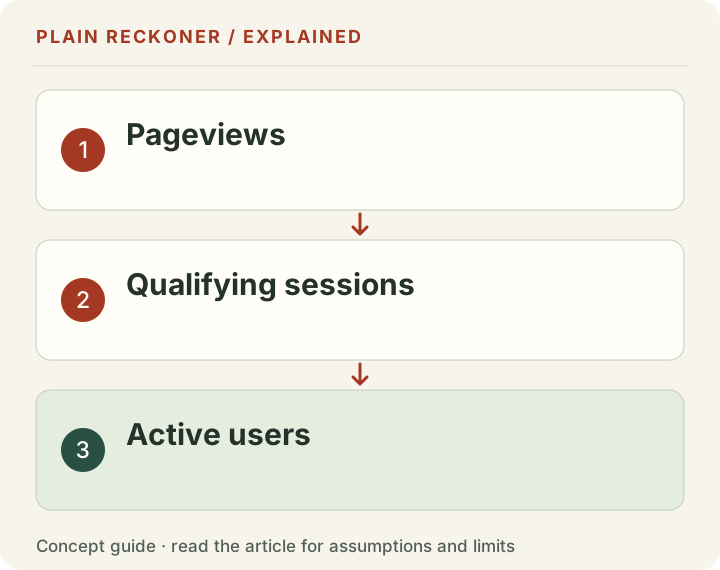
A pageview counts a viewed page. A session groups activity into a visit. An active-user metric counts people under the analytics system’s engagement definition. Annual advertising revenue is money over a specified reporting period. Changing one does not establish the others.
A hypothetical site can have 100,000 pageviews, fewer than 100,000 sessions, fewer active users still, and an entirely separate annual revenue total. Its country mix might clear one provider’s conditions and miss another’s. There is no universal pages-per-session ratio or RPM that can turn this into a confirmed application result.
This is why our network tool describes its output as a scenario shortlist. A public scan cannot read the private analytics, account history or content review needed for a provider’s decision.
Choose the next check from the evidence you hold
If you have meaningful existing advertising revenue, start with the annual figure and its reporting period when reviewing Mediavine Official. Do not multiply one strong month by twelve and label the result earned annual revenue. AdSense may be one source of advertising income; it is not the only possible source, and this article previously overstated its role.
If your site is earlier in its growth, read which sessions count for Journey. If pageviews are the figure you can document, check Raptive’s smaller-site audience condition before assuming a 25,000-view total is enough.
For Ezoic, establish whether you are a new applicant, a continuously monetizing pre-cutoff publisher or a potential exception-program applicant. The active-user and grandfathering explanation keeps those routes separate.
Eligibility does not predict earnings
None of these entry numbers is an RPM promise. A network can have a lower entry threshold and still be unsuitable for a particular site’s content, audience or reader experience. Compare actual revenue using matched dates and traffic units; the page-versus-session RPM example explains why a larger dashboard number alone is not evidence of improvement.
For recently launched Journey ads, check the reporting-window diagnosis before deciding that an early average proves a network comparison.
Correction and limitation: this October revision uses sources available now; it does not rewrite what was accessible during the August check. Provider criteria can change again, and meeting numerical criteria does not guarantee acceptance. Evidence grade: A: dated provider documentation, not an independent application trial.
Considering a move? Check whether switching ad networks pays after fees and traffic changes before comparing headline RPMs.
For a separate comparison of platform rules and setup costs, read Monumetric vs Mediavine and Journey. It includes a fee-payback example rather than an unverified RPM ranking.
Where AdSense fits without inventing a traffic minimum
Google's general AdSense eligibility page describes original content, policy compliance, site control and an eligible adult account holder. The named general page does not publish a universal pageview quota. That is a statement about this source, not a promise that every site or regional situation has identical conditions.
AdSense therefore does not belong in a ladder with a guessed traffic number taken from a forum. A site still needs useful content, working navigation, account setup and Google's review. No public calculator can establish a private approval outcome.
Keep ownership verification and active advertising separate, too. A publisher meta tag or ads.txt record can support a connection step while live ads remain disabled. Not detecting an advertising script in a public page does not by itself mean the application was never connected.
Use the AdSense setup guide for the account-versus-site workflow. It is a different task from comparing the pageview or revenue gates of other providers.
One site can meet one gate and miss another
Take a chosen example with forty thousand monthly pageviews, twenty thousand total sessions, twelve thousand active users and a 45% compatible share from Raptive's listed countries. Suppose the site also has $4,000 of documented annual ad revenue.
The pageviews exceed Raptive's general floor, but the chosen country share falls below the smaller-band condition. The active-user count falls below Ezoic's general new-site requirement. The annual ad revenue falls below Mediavine Official's listed gate. The total sessions do not establish Journey's qualifying count because that narrower population remains unknown.
This is not a real publisher assessment. It shows why four large-looking numbers cannot collapse into a single “eligible” answer. Some results are below a stated gate, one has a separate condition unmet and one remains unresolved from the inputs.
If the same site's annual ad revenue later reaches the published Official gate, that changes the revenue check. It does not retrospectively prove its country share, active-user count or technical compatibility. Each requirement needs its own evidence and period.
Unknown is a useful status
A professional requirements screen needs at least three outcomes: supported by the stated figures, below a published condition and needs confirmation. Reducing everything to green or red hides the difference between a failure and a missing input.
A blank geography share should remain unknown. An assumed pages-per-user ratio should remain a scenario. An old account without confirmed continuous monetization should not receive a permanent grandfathered badge. A threshold check should not become a promise that the provider will accept the content.
That uncertainty points to the next action. A missing metric calls for the relevant report. An unclear exception calls for the provider. An implementation question calls for a technical review. A below-minimum count calls for legitimate audience development or a different route.
A clear unresolved result can save more time than a reassuring answer constructed from guesses. It shows exactly which fact would change the shortlist.
Keep the qualifying population beside the count
A session total may cover all traffic, a monetized subset or a provider-defined qualifying group. A user total may describe active, total or new users. The same word in a headline can conceal a different source field.
Record the original metric label and source. Do not translate every measure as “visitors” in a localized interface. The translation should preserve the unit and period, even if the plain-language explanation comes first.
For percentages, record the denominator as well as the country names. A share of users from listed countries is not automatically the same as a share of pageviews. If the provider's wording leaves a scope unclear, ask instead of silently choose whichever report gives a passing result.
For annual revenue, preserve the exact earned period and what qualifies as advertising income. Affiliate commissions, product sales and a single strong month's run rate should not quietly become documented annual ad revenue.
Exceptions need site-specific history
An exception is not a general removal of the rule. Ezoic's older-publisher route depends on history and continued use under its published support description. Its public pages also have a cutoff-date wording conflict, discussed in the linked individual guide. Borderline cases need provider confirmation.
A new site on an existing account is not automatically the same case as the original site. A domain's registration date is not the same as its first monetization date. A script visible today cannot establish continuous use months ago.
Keep the supporting account record and the provider's dated response. Do not publish private account details to make a public comparison look more authoritative. The general guide can identify the question without certifying a particular exception.
The same discipline applies to selective programs. A limited intake establishes an application route, not an acceptance probability. Without a known applicant population and decision record, a published number of places cannot produce a meaningful chance of success.
A requirements change is news, not a performance test
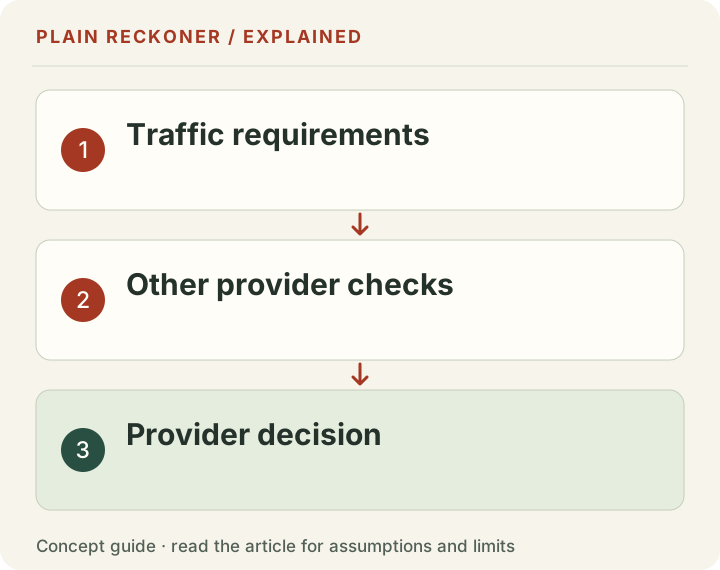
Provider rule changes can create a useful reason to revisit options. Raptive's lower entry point, Mediavine's revenue-based Official gate and Ezoic's current audience minimum affect which routes a publisher might investigate.
Those changes do not establish which provider earns more on comparable sites. A lower barrier can expand the applicant pool without changing the economics for your audience. A larger minimum can describe the provider's positioning rather than a guaranteed higher rate.
When writing or sharing the news, keep the claim narrow: what changed, which unit it uses, which conditions remain and when the source was checked. Do not add a universal earnings winner to make the headline more dramatic.
A useful comparison can still be interesting without that overclaim. It helps a publisher avoid chasing an obsolete target or applying with the wrong metric, then points to a cost-aware decision after the provider responds.
Review the reader experience before accepting an offer
The technical setup must support the provider's applicable placements without breaking the main task. Inspect long articles, short pages, calculators, navigation and forms on mobile as well as desktop.
Check whether the proposed ad behavior obscures a result or moves a control during interaction. Ask which placements are required and what can be adjusted. A provider's published traffic minimum does not settle those practical details.
Then compare costs. One-time setup, additional recurring charges, implementation work, payment timing and guarantee conditions can matter as much as a quoted rate. Normalize revenue definitions before running a switching scenario.
Keep the rate and the audience together. A higher page RPM with materially fewer pageviews can leave less money. A larger monetized-session RPM can result from a smaller denominator while revenue stays unchanged. The linked guides explain those arithmetic distinctions; the actual offer still needs your reports.
Make a source table that survives the next update
For each provider, record the program, exact gate, unit, period, additional conditions, source URL and date checked. Keep a field for unresolved wording and site-specific questions. Do not overwrite a historical policy table and then claim old applications were judged by the new rule.
On refresh, open the original provider source. An article date, search snippet or remembered screenshot is not enough. Check whether the program name, default reporting metric or exception route changed.
Preserve the old publication date of your explanation when you revise it. State which source facts were rechecked and which historical calculations remain historical. That makes a current guide more trustworthy than relabeling every figure as newly measured.
If a source is unavailable, record the limitation. Do not fill the gap with a competitor's unsourced threshold and call it verified. A missing answer is better than a precise requirement no one can trace.
Leave with one concrete next step
Start with the metric you can document and the route that appears relevant. Resolve the biggest unknown before spending on a migration or applying repeatedly. Save complete dates and the provider's actual response.
Use the free requirements screen as an organizing tool. Use official provider channels for the decision and private account checks. Use your own cost and audience records to judge the eventual offer.
The result should be a short, defensible sentence: which public conditions your evidence appears to meet, which it does not and which still need confirmation. That is a better basis for action than a traffic ladder assembled from incompatible units.
Check how a shortlist changes when one input changes
A useful requirements check should be understandable enough to test. Keep all inputs fixed and change only the active-user count. Only the rules using that count should change. Changing a pageview estimate should not silently rewrite annual earned revenue or an independently entered country share.
Then test the boundary values. A value exactly at a stated minimum needs the comparison described by the source. A value just below should not be rounded into a passing count. A missing required field should stay unresolved rather than inherit an example that looks like the visitor's own result.
These checks protect interpretation, not provider acceptance. They establish whether the tool applies the public rule to the stated scenario consistently. They do not establish that the input report is accurate or that the provider has no additional conditions.
If two screens disagree, compare their assumptions before deciding either is broken. One may use a historical example while the other uses the visitor's entered metrics. Make those states explicit. A professional shortlist is one whose working can be inspected, not one that produces a confident answer for every incomplete set of inputs.
Keep the matching source dates visible in shared results.