
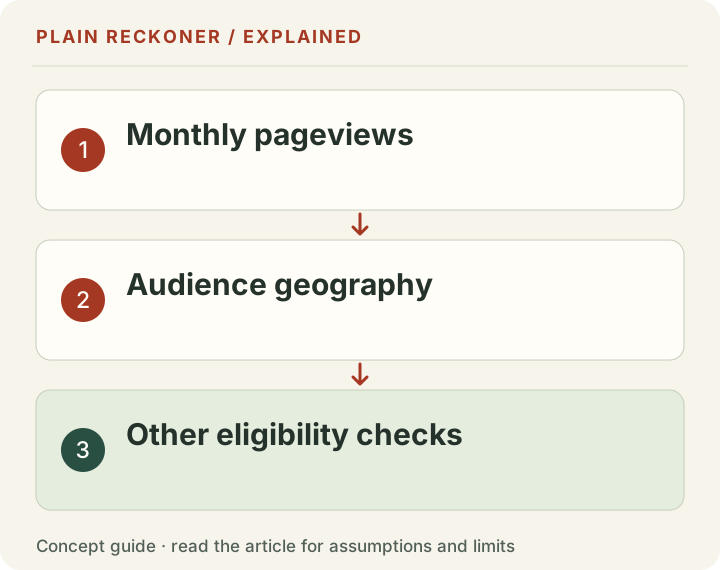
A site with 30,000 monthly pageviews can clear Raptive’s volume minimum and still miss its audience-share condition. Treat these as separate checks before spending time on an application.
The current eligibility page sets a 25,000-pageview floor. For the 25,000–99,999 band, at least half the traffic must come from the US, UK, Canada, New Zealand or Australia combined. At 100,000 pageviews and above, the stated share is 40%.
Those are the provider’s published requirements, checked on 19 October 2026. They are not an independently measured acceptance rate or a promise of earnings.
Check the band before the percentage
| Monthly pageviews | Published share from the five listed countries |
|---|---|
| Below 25,000 | Below the general pageview minimum |
| 25,000–99,999 | 50% |
| 100,000 and above | 40% |
Do not use the 40% condition just because a large publisher mentions it. Its traffic band may be different from yours. Conversely, do not infer that an additional pageview always makes qualification harder: the published rule changes at the upper boundary.
A worked application check
Imagine a site reporting 30,000 pageviews in a complete 30-day period. Its country report shows a 45% share from the named markets, using the same dates and traffic measure. That share is five percentage points short of the smaller-site condition, even though the volume clears 25,000.
This is an illustrative example. It illustrates the separate questions an applicant must answer; it does not estimate the applicant’s chance of approval. The provider describes the condition as a share of traffic. Do not quietly substitute a users-based percentage from a different report or multiply total pageviews by an unrelated country metric to certify eligibility.
A useful application record contains the reporting window, total pageviews, country breakdown, metric names and analytics property. Keep the source export so a reviewer can see which population each number describes. Our source table download preserves the policy units and source URLs separately.
Other checks still matter
The eligibility page also lists a six-month domain age, accurate Google Analytics tracking and original content with meaningful human involvement. In the lower traffic band, it specifies long-form content on most pages and a site that can support its ad setup.
The analytics authorization explanation describes read-only access for reviewing traffic. Before granting any service access, inspect the permission screen, confirm the provider’s domain and select the correct property. A public website scanner cannot see that private reporting or replace the provider’s review.
Qualification is different from network choice
Being able to apply does not tell you whether switching improves your business. Compare the same earning period, the same traffic denominator and the reader experience. A provider quoting page RPM and another quoting session RPM can show different numbers with identical revenue: our matched-denominator example shows the arithmetic.
For the wider route, see the current network requirements comparison and Journey’s premium-session requirement. The networks tool provides a scenario shortlist; it does not verify country shares, private analytics or acceptance.
Evidence grade: A. Published provider criteria plus a clearly hypothetical application example. There is no site-specific eligibility decision, network performance benchmark or independent approval study here.
Why older comparisons can point to the wrong gate
Raptive's announcement opening the network to more creators describes the move to a lower pageview entry point while retaining quality requirements. It is a real provider policy change, not evidence that every smaller applicant is now accepted.
An old article can therefore be accurate about its publication period and unsuitable for today's application. Before using a comparison, inspect the actual provider source and its current units. Updating the year in a title does not establish that someone rechecked the rule.
The current pageview threshold answers when a site can be considered under the listed entry conditions. It does not establish a revenue rate, approval probability or ranking benefit. Keep those claims separate even when a marketing page presents them close together.
The country share is a combined group
The listed-country condition combines the named markets. It does not require each of the five countries to produce half the traffic. Use a report whose metric and dates match the provider's intended review.
For a chosen illustration, suppose the relevant report shows 30% from the United States, 10% from the United Kingdom, 5% from Canada, 3% from Australia and 2% from New Zealand. The combined share is 50%. That arithmetic meets the stated share threshold for the smaller band, provided those percentages actually use the required scope.
Do not add percentages with different denominators. A US share of users and a UK share of sessions cannot simply be summed into a traffic qualification figure. A country breakdown for one week cannot be attached to a pageview total from a different month.
Keep unknown countries and unavailable classification visible rather than allocate them to the qualifying group. A source may omit a row for privacy or reporting limits. Missing data does not become proof of eligible geography.
A share can improve while the audience gets smaller
A percentage alone does not reveal volume. In a chosen example, ten thousand listed-country observations out of twenty thousand total are fifty percent. The same ten thousand out of twenty-five thousand total are forty percent.
The eligible-country count did not change, but the share changed because the other traffic changed. Conversely, reducing the nonlisted audience can raise the share without acquiring a single additional reader in the listed countries.
This example is about denominators, not an instruction to remove useful readers. A provider's audience fit is one business condition. It is not a score of whether visitors elsewhere deserve the content.
Review absolute counts alongside the share and the correct pageview band. A site can have a high share but miss volume, or enough total pageviews but miss the relevant share. Keeping both checks separate prevents one attractive number from hiding the other.
The band boundary makes the rule discontinuous
The published share requirement changes at the upper pageview band. That means a scenario just below one hundred thousand pageviews can have a different required share from a scenario at or above it.
Consider two chosen cases. A site at ninety-nine thousand pageviews with a 45% compatible listed-country share misses the smaller-band 50% condition. A site at one hundred thousand with that same share clears the published larger-band 40% condition. Neither case establishes final acceptance because other checks remain.
The point is not to chase an extra thousand questionable views. It is to implement the public rule correctly. A calculator that always applies fifty percent or always applies forty percent will misstate one of the bands.
Check exact boundaries and units in any tool you use. Twenty-five thousand pageviews is not twenty-five thousand users. A rounded display saying “100k” may conceal a value below the precise boundary. Use the underlying count for the rule and show enough information to understand the decision.
Domain age and business history are different
A domain's age does not by itself show how long the current website has operated, when the current owner acquired it or whether its content and audience stayed the same. Keep those histories separate when preparing the application.
If the age is unclear, confirm the evidence the provider expects rather than infer it from the date of the first blog post. A migrated publication may have an older content history than the current domain. An old domain may host a new business.
Do not buy or describe an old domain as a guaranteed eligibility shortcut. The source lists other quality and tracking requirements, and the actual reviewer evaluates the site. A date field cannot establish the audience, content rights or technical fit.
For your records, note the known domain history, ownership or migration events and the dates supported by evidence. Mark uncertainty instead of inventing a founding date to make the form look complete.
Accurate analytics is more than a visible tag
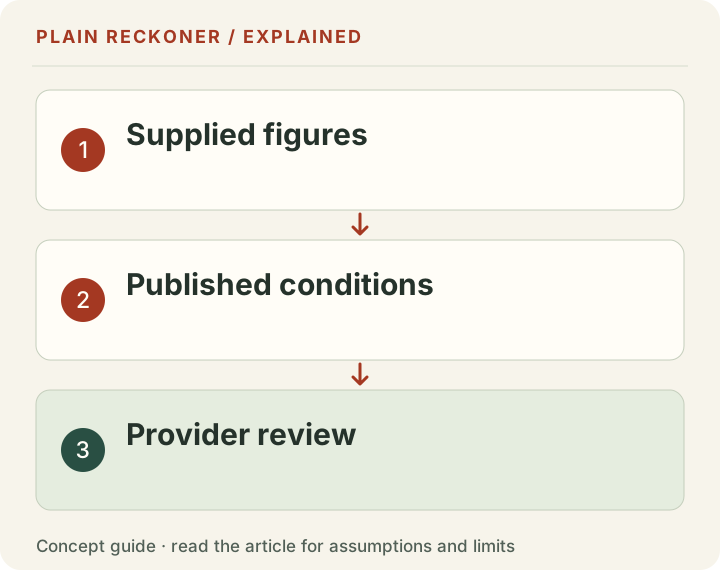
A script signature on a public page suggests an integration may be present. It does not prove that the correct property receives all relevant traffic or that its configuration matches the application.
Check the property and data stream, hostnames, reporting dates and any changes to consent or measurement. A total that includes a staging site or another domain may not describe the submitted publication. A broken tag can undercount; duplicate events can overcount some metrics.
Before authorizing a connection, inspect the provider's official permission request and choose the intended property. Read-only access should still be granted deliberately. Do not share a password or access token with a third-party comparison tool.
If private counts differ, ask a focused question about scope and dates. A public eligibility screen cannot reconcile an account it cannot see. It should report which requirements appear met from your stated inputs and which need confirmation.
Prepare the site for people, not just the minimum
Read a representative article on a phone. Can a visitor understand the topic, navigate the content and use important controls without confusion? Check the actual image rights, sources and original material behind the page.
A long article is not automatically a good article. The provider's content conditions do not justify padding a page with repeated paragraphs. Useful depth comes from answering the reader's question, showing relevant evidence and helping with the next decision.
Likewise, an ad-compatible layout should not obscure a calculator result, menu or form. Ask about required placements and inspect how they interact with the site. The current content and technical conditions should be reviewed together rather than treat traffic volume as the whole application.
These improvements benefit readers even if the provider declines the site. They are not an approval formula, but they leave you with a more useful publication and clearer evidence of what works.
Acceptance and a profitable switch require different analysis
Suppose you meet the published entry conditions. The next question is whether the actual offer improves the business after costs and reader-experience effects. The eligibility table does not answer it.
Use the same traffic denominator for current and proposed earnings. Session RPM, page RPM and monetized-session RPM can differ while describing the same money. Include setup work, extra recurring costs, the comparison period and any conditions on a guarantee.
The switching-cost guide provides an explicit scenario model. It does not predict a particular network's rate. A higher assumed rate can fail to cover implementation costs over your chosen horizon, especially if other inputs change.
Keep payment timing separate as well. Earned revenue and money available in the bank can occur on different dates. A switch that appears favorable over six months may still require cash to fund the transition.
A concise application evidence record
Use one table with the requirement, current official source, your matching evidence and unresolved questions. Record complete pageview periods, the audience metric and share, the analytics scope, domain history and content/technical review.
Do not use an estimated qualifying percentage as a confirmed pass. Do not label a missing input a failure without explaining that it is unknown. Distinguish an application being considered from an application accepted under an actual agreement.
Save the date checked. If the provider changes a threshold, revise the source row and retain a note. If your traffic window moves, update the evidence rather than compare it silently with an old screenshot.
Then use the requirements tool to organize the public checks. It can help identify the next question, but the provider decides the application and the agreement determines the offer. That boundary makes the result more useful, not less professional.
Check the application with boundary scenarios
A requirements screen should distinguish a supported result from an unresolved input. Try a pageview count just below the minimum, one exactly at it and one at the larger-band boundary. Confirm that the displayed band and share condition change according to the current published rule.
Then leave the geography share blank. The result should say that the share needs confirmation, not assume zero or one hundred percent. Enter a share outside zero to one hundred and confirm that the input is rejected rather than treated as an unusually strong audience.
Domain age needs the same care. An unknown age should remain unknown. A date in the future should not create a valid positive age. If the source only gives an approximate date, preserve that uncertainty rather than present a precise eligibility decision.
These checks test the interpretation of public rules. They do not access the provider's private review or measure acceptance rates. A passing software test means the stated scenario follows the implemented rule, not that a real application will be approved.
Preserve reader purpose when planning growth
If the site falls short of one condition, identify whether working toward that provider fits the audience you want to serve. A publication aimed at a different language or market may have a legitimate purpose even if its current country mix does not fit this program.
Do not change the site's claimed region or buy artificial visits to make the percentage appear favorable. Use accurate account information and real audience evidence. Consider alternative monetization approaches separately, with their own costs and requirements.
The professional outcome is a defensible decision about fit, not a checklist designed to hide inconvenient facts. Clear definitions help you spend time on the applications and improvements that actually match the business.