
A site with 300,000 pageviews does not automatically meet a 250,000-active-user requirement. The unit matters as much as the headline number.
Ezoic’s current requirements documentation generally asks new applicants for at least 250,000 monthly active users. Older no-minimum guidance does not describe this general route.
The same page preserves an exception for publishers monetizing before 19 February 2026 who maintain use. It says an integration removal exceeding seven days voids that status; new sites added after the cutoff must meet the new requirement. It also describes an Incubator possibility below the general threshold, without promising every applicant entry.
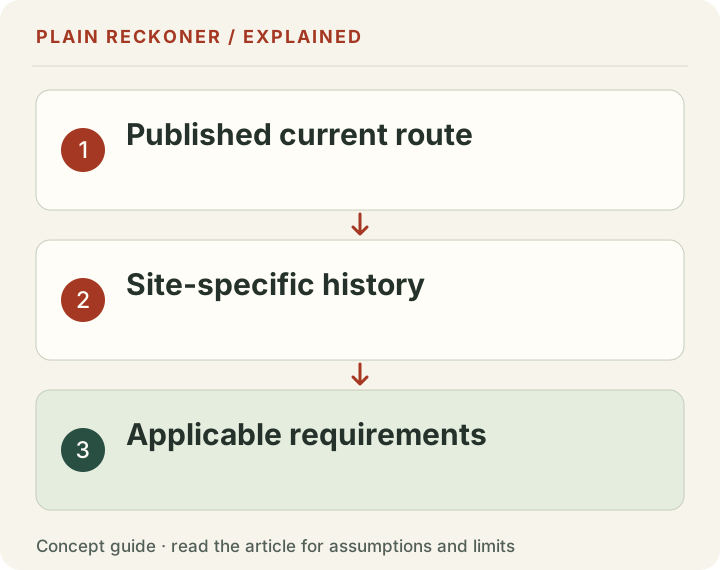
Identify your route first
| Situation | What to verify |
|---|---|
| New site applying now | General active-user requirement and current quality rules |
| Previously monetizing before the cutoff | Account history, continuity and the provider’s confirmation |
| Additional site on an older account | The new site’s own eligibility; do not assume it inherits an exception |
| Site below the general minimum | Whether the current Incubator application is available and appropriate |
This is a routing check, not an approval calculator. A historical account does not, by itself, establish continuous monetization for every domain attached to it. Ask support about ambiguous interruptions before changing integrations; do not treat a generic checklist as authorization to remove and restore scripts.
Why pageviews cannot answer the user question
Consider a hypothetical monthly report with 300,000 pageviews, 180,000 total users and 140,000 active users. The largest number clears 250,000, but the relevant active-user count remains 110,000 short.
Those chosen example figures are a counterexample to a pageview shortcut, not a benchmark for pages per user. There is no universal conversion ratio that recovers active users from pageviews. Repeat reading, return visits, measurement settings and engagement all affect the relationship.
Google’s GA4 user-metric reference distinguishes total users from active users and describes the engagement signals involved. Record the actual metric name and date range in your export. Do not add daily unique-user counts to produce monthly unique users: the same person can appear on several days, so that sum can count them repeatedly.
Build a checkable application record
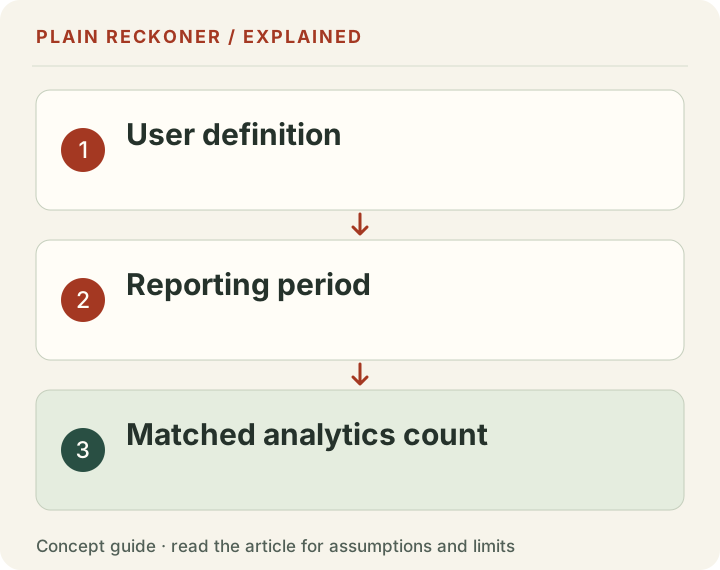
Save one complete reporting window, the property identifier and the active-user total for that window. Keep pageviews and sessions as separate columns. If you believe an exception applies, retain account dates and ask the provider to confirm its interpretation for the specific site.
Our downloadable requirements table records the source, unit and exception instead of presenting every threshold as visits. The network shortlist is only a scenario: its pageviews-per-user assumption cannot verify your active-user count or grandfathered status.
What to compare if you cannot use the general route
Start with requirements you can actually document, rather than a universal best-network ladder. Journey measures a qualified session population, Raptive uses pageviews plus audience conditions, and Mediavine Official uses annual advertising revenue. Those gates do not share one denominator.
See the current network comparison, Raptive’s traffic-share conditions and Journey’s qualifying-session explanation. None is a recommendation to buy traffic, promise ad income or bypass quality review.
Evidence grade: A. This explains current provider statements and metric definitions. We have not measured account acceptance, earnings, support quality or the availability of a place in an exception program.
The provider's pages disagree at the cutoff edge
There is a detail worth resolving before making an integration decision. The support requirements page describes publishers monetizing before 19 February 2026 and a more-than-seven-day interruption rule. The public Incubator page instead refers to active use before 18 February 2026 and describes returning sites more generally.
We do not silently choose the more favorable description for an owner near those dates. Ask Ezoic to confirm the status of the specific site and interruption history. Save the response before removing an integration if the exception matters to your options.
This source conflict does not establish bad intent or prove that every older account is uncertain. It identifies a narrow boundary where public wording alone is insufficient. A tool should show “needs provider confirmation” rather than infer a permanent exception from the age of the account.
Keep account creation, first monetization and continuous site use as separate facts. An account existing before the cutoff does not necessarily establish that this particular domain was monetizing then. A second site added later is another case again.
Monthly unique users cannot be added from daily totals
Suppose a chosen site records ten thousand active users on each of thirty days. Multiplying gives three hundred thousand daily user observations. It does not establish three hundred thousand distinct monthly active users.
At one extreme, the same ten thousand people could appear every day. At another, each day's people could be different. Real identification and reporting can be more complicated, but the basic overlap problem remains. The monthly distinct count needs the source system's calculation for that full period.
The same caution applies across devices, countries and overlapping segments. Adding unique-user counts from groups that can contain the same person may double-count. Record the actual monthly metric rather than build it from convenient daily or segmented rows.
This is why a pageviews-per-user assumption cannot certify the general requirement. It can illustrate a relationship, but it does not reveal the distinct, active population observed by the provider's connected reporting source.
Total users and active users are not alternate labels
The original example has three hundred thousand pageviews, one hundred eighty thousand total users and one hundred forty thousand active users. Those numbers were chosen to make the unit mismatch visible. They are not an estimate of a typical publisher's engagement.
Use the exact metric from the report. A dashboard's short “Users” label can be ambiguous without its definition. Check whether the export names active users, total users, new users or a provider-specific audience measure.
Google's current reference describes active-user signals in its own analytics system. It does not establish a universal conversion from a page count or prove that a third-party estimate uses the same identity and engagement rules.
If the provider asks you to connect analytics, verify the correct property and site scope. A total including another domain or a test environment is not automatically the audience of the applying site. A public scan may see a tag but cannot validate the private property contents.
An Incubator application is a separate route, not a hidden bypass
Ezoic's Incubator support page describes a competitive application for sites below the general audience minimum. It states a limited monthly intake and that applying does not guarantee acceptance. That is a provider-published process, not an independently measured chance of admission.
Do not divide the published monthly places by an unknown applicant count and call the result an acceptance rate. We do not have the denominator, the review distribution or an independent record of the decisions.
The support page also describes a one-application-per-site process. Read the current dashboard and official instructions rather than repeatedly submit the same site as a growth tactic. The public page's wording and a particular account's state still need to be matched carefully.
A below-threshold publisher can investigate that route while also comparing other providers' published conditions. The existence of Incubator does not establish that it is the best choice, that a place is available or that the resulting earnings exceed alternatives.
More audience is not a substitute for content and policy fit
Meeting a traffic quantity is only one part of the provider review. The current requirements page includes content and policy considerations. Do not treat a large counter as permission to publish copied, unsupported or misleading material.
Inspect the actual user path. Does the site explain its purpose, deliver useful content and keep navigation clear? Do the images have appropriate rights? Do calculators label their examples and limitations? Can someone complete the primary task on a phone?
Those are practical quality questions, not a formula promising acceptance. An independent site may meet public numerical conditions and still receive a different provider decision based on evidence a third-party tool cannot see.
Avoid buying traffic to make a number pass. Artificial visits can create a larger reporting problem and do not establish an engaged human audience. If legitimate growth changes the site mix, inspect the new audience and revenue economics rather than assume every added user has the same commercial effect.
A qualifying user total does not set an earnings rate
The general entry gate counts an audience measure. Revenue per thousand users or visitors is another calculation. A threshold does not establish how much each user earns, whether they receive ads or which rate the provider will deliver.
Take a chosen scenario of two hundred fifty thousand monthly users. A hypothetical $2 revenue rate per thousand of those same users gives $500; a $5 rate gives $1,250. Those outputs illustrate the multiplication only. Neither rate is a measured Ezoic expectation, and the public minimum does not select between them.
Do not insert our historical page-RPM median into that user-based formula. It uses pageviews from selected historical businesses, not the same denominator or provider population. A larger rate can be meaningless when the unit changes unnoticed.
If you have an actual offer or existing report, preserve its complete metric name, dates, revenue deductions and traffic count. Normalize only where the source populations genuinely match. Otherwise keep the rates separate and ask for the missing definition.
If you are changing an existing integration, separate the risks
There are at least three questions: whether the site retains a documented route, whether the new setup works and whether changing improves the business. A single eligibility badge cannot answer all three.
First resolve any grandfathering ambiguity with the provider. Then inspect the technical implementation and applicable agreement. Finally compare earnings, recurring costs, one-time work and payment timing using explicit assumptions.
The switching planner models a constant-rate scenario over a chosen period. It does not interpret the contract, assign a probability to future traffic loss or certify exception status. Keep those unknowns beside the calculation.
A short interruption may also have operational consequences outside the audience rule. Do not remove scripts or files simply to experiment with what the application reports without a clear rollback and the provider's applicable guidance. Preserve the original setup and source records so later differences can be understood.
Build a source-backed comparison with other routes
Journey, Raptive, Mediavine and Ezoic use different entry measures. A table that labels every minimum “visitors” erases the distinction the owner needs most. Keep pageviews, qualified sessions, annual revenue and monthly active users in separate columns.
Then add the relevant nonnumeric checks and unknowns. A site might satisfy one traffic floor but miss platform fit or country share. Another might have enough annual ad revenue without the worldwide session total people remember from an older article.
The aim is a shortlist of routes worth asking about, not a league table of guaranteed earnings. A provider accepting a smaller site does not prove it pays less. A higher minimum does not prove it pays more. Those comparisons need different evidence.
Use the network requirements guide for the public source summary and the individual articles for the details. Keep the current check date visible because a remembered rule can become obsolete.
Test the input interpretation before relying on a tool
A requirements tool should ask for the actual active-user figure if that is what it needs. If it offers a pageviews-per-user estimate, the result should stay a scenario and preserve that limitation prominently.
Try a missing active-user value. The correct status is unknown, not a pass derived from an unrelated pageview total. Try a negative count or a nonnumeric value; those should not create an eligibility result. Try an exact boundary value and verify the implemented comparison matches the current published wording.
Exception status needs its own input or provider confirmation. It should not be inferred from the current traffic figure, the age of a domain or the presence of an advertising script. A fresh scan cannot recover the necessary historical account facts.
Finally, save the source and date behind the rule. A future change should produce an explainable update rather than silently alter an old shared result. That makes a public checker a useful preparation tool while preserving the provider's role in the actual decision.
Keep the unanswered question small
If you cannot determine the correct route, state the exact missing fact. Is the uncertainty the active-user total, the reporting period, the site's monetization history or the provider's interpretation of an interruption? Each points to a different source.
An analytics export can resolve a metric question. A historical account record can support a date. A provider response can clarify its rule for the specific site. A public comparison page cannot substitute for all three.
Prepare that question without exposing private credentials or personal visitor records. A concise description of the dates, metric labels and account status is normally a better starting point than a full unfiltered export sent to an unrelated reviewer.
Keep the response with the dated source table. If the answer changes a scenario, update the assumption and explain why. The useful result is a defensible next action, whether that means applying through the general route, investigating Incubator, confirming older status or choosing another option.
Retain the original support response so later changes remain traceable.