Profit does not tell you how much cash you can spend today. A store can sell products at a healthy margin while paying for stock before the related customer money reaches its bank. That timing can turn a busy month into a cash problem.
The Australian government’s cash-flow guidance is a useful starting point for separating money coming in and going out. Your accountant’s profit report and your bank statement are both useful. They measure different things.
A profitable month with less money in the bank
In this worked example, a store records $10,000 of sales, $5,000 of product cost for the goods sold, and $3,000 of operating expenses. Its simplified profit is $2,000. This excludes taxes, depreciation, financing and other adjustments.
Now look at cash. Only $7,000 of the sales is collected during the month. The store pays $6,000 for stock, including $1,000 that remains unsold. It also pays the $3,000 of operating expenses during the month.
| Cash movement | Amount |
|---|---|
| Cash at the start | $4,000 |
| Customer money collected | +$7,000 |
| Stock payments made | −$6,000 |
| Operating payments made | −$3,000 |
| Cash at the end | $2,000 |
Profit is positive $2,000. Cash falls by $2,000. The $3,000 not yet collected and $1,000 of extra stock explain the $4,000 difference between profit and cash movement in this simplified example. No mystery fee is needed.
Separate sold stock from purchased stock
Product cost in a profit report usually follows the products sold under the accounting method used. A cash ledger follows the payment date. Buying 500 units does not mean that all 500 units were sold this month.
This matters before a holiday promotion. A supplier may require a deposit or full payment before the goods arrive. A profitable price does not fund that payment by itself. Build a dated stock-payment plan, including any freight, duties and packaging that you actually pay.
The bundle and stock calculator helps check how many complete bundles current stock supports. It does not tell you when a supplier invoice is payable or when your payout will arrive. Keep those dates in the cash plan.
Reconcile the payout separately
Shopify’s payout documentation distinguishes payout scheduling from the money reaching a bank. Refunds, adjustments, reserves and bank processing can also affect the transfer. Use the actual schedule and transaction details for your account.
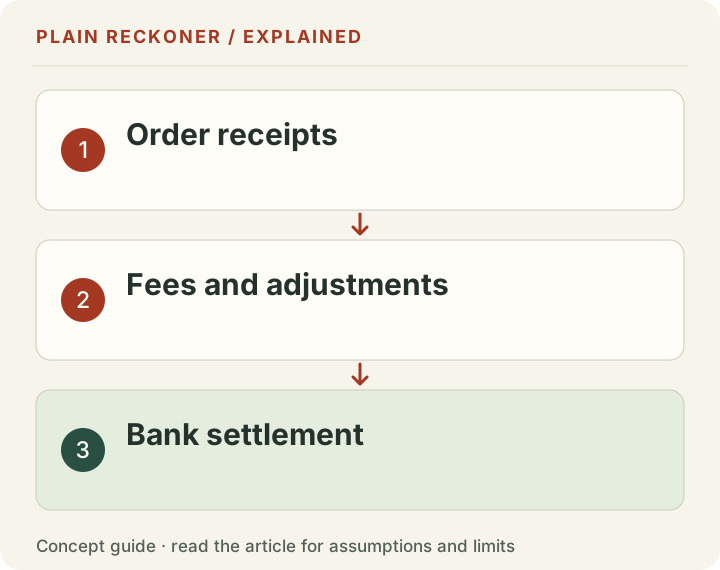
Start with settled sales in the processor report. Subtract the fees and adjustments shown there. Match the resulting payouts to bank deposits. Do not count both the customer sale and its later payout as two cash receipts. If money remains pending, put it on the expected date, not in today’s available balance.
Make a short cash plan you can update
Use one row per week. Record opening cash, expected collections, stock and supplier payments, operating payments, tax or debt payments where relevant, and closing cash. The next week starts with the preceding week’s closing balance. Keep uncertain collections separate from confirmed money.
Test a delayed-payout case and a lower-sales case. These are scenarios, not forecasts. If cash becomes negative before a payout arrives, a positive month-end balance does not remove that earlier gap. That is why weekly dates can be more useful than a single monthly total.
Keep a contribution check beside the cash plan
The order profit calculator checks what an order cohort leaves after entered costs. The cash plan checks when payments happen. Use both. A cash inflow funded by a loan is not a product margin, and recovered stock from a return is not an immediate bank deposit.
Before spending on another campaign, answer two questions: does the order make a useful contribution, and can the business cover the dated cash commitments? If the reports disagree, reconcile the timing and definitions before changing prices or assuming the business is failing.
Rebuild the bridge from profit to cash
The opening example has a simplified $2,000 profit and a negative $2,000 cash movement. Reconcile the difference explicitly rather than conclude that one report must be wrong.
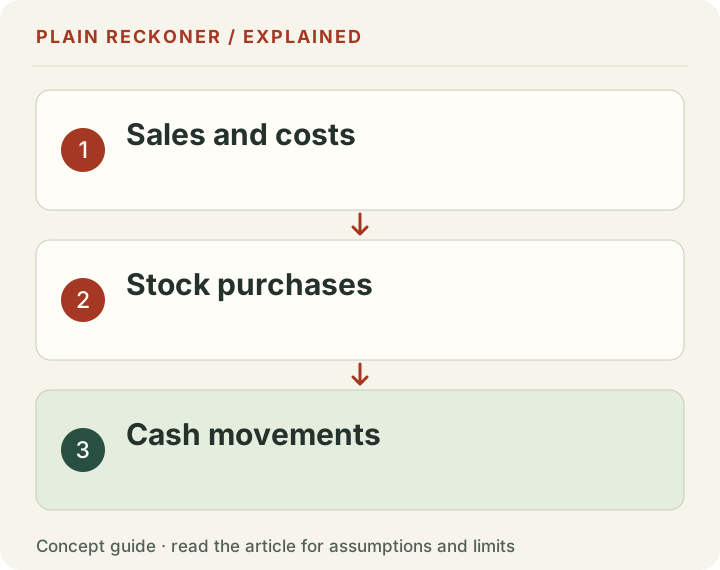
Start with the $2,000 profit. Subtract the $3,000 of recorded sales not yet collected. Subtract the $1,000 paid for additional stock that remains unsold. The result is negative $2,000 cash movement. Add that to the $4,000 opening balance and the ending cash is $2,000.
This bridge assumes the other named expenses were paid in the same period and no other movements occurred. If the real business has unpaid supplier invoices, debt, tax payments, equipment purchases or owner withdrawals, those need their own entries. Do not force the real bank movement to equal the small example by hiding a balancing amount in “other.”
The US Securities and Exchange Commission's introductory statement guide distinguishes income, balance-sheet and cash-flow information. The general distinction is useful even for a smaller store: profit and cash movement are different measures, while inventory and amounts owed describe another part of the position.
A positive month-end balance can hide a midmonth gap
Monthly totals do not reveal the order of payments. A chosen two-week example makes that clear.
Begin with $2,000 cash. A $2,500 supplier payment is due in week one, before a $3,000 processor receipt arrives in week two. Ignoring every other movement, the month ends at $2,500: opening $2,000 minus $2,500 plus $3,000.
But week one's planned balance is negative $500. You cannot pay that supplier in full from the stated available cash without another funding source or an agreed timing change. The later receipt does not make the earlier gap disappear.
Swipe or scroll the table horizontally to see every column.
| Week | Opening cash | Confirmed receipts | Payments due | Closing cash |
|---|---|---|---|---|
| One | $2,000 | $0 | $2,500 | −$500 |
| Two | −$500 | $3,000 | $0 | $2,500 |
The negative row is a warning in a planning sheet, not an assumption that the bank will automatically lend $500. Record any actual financing separately, with its terms and repayment. Otherwise the worksheet implies a funding source the business does not have.
Sales growth can increase the cash requirement
More orders often require more inventory, packaging, advertising and fulfillment before the related receipts arrive. A positive contribution per order does not mean the business can fund an unlimited increase in orders this week.
Take a separate scenario in which each order leaves $10 contribution after the named costs, but requires $30 of payments before its customer money becomes available. Fifty additional orders create $500 of contribution under the model and require $1,500 of earlier funding. The contribution and the funding requirement describe different parts of the same activity.
This does not establish a universal working-capital ratio. Your supplier terms, inventory already paid for, customer payment timing and costs determine the actual requirement. Keep the chosen figures labeled and replace them with your records.
Before scaling a campaign, model a lower-sales case and a higher-orders case. Lower sales can delay receipts. Higher orders can accelerate supplier and fulfillment payments. A business can face a cash problem in either direction for different reasons.
Do not count the processor transfer twice
A customer payment and the later bank payout are stages in the same flow. If you count the original payment as a cash receipt in the bank and then add the payout again, you overstate available bank cash.
Keep a processor balance separate from a bank balance when necessary. Start with the processor's opening balance, add the relevant transactions, subtract refunds, fees and other adjustments, then subtract payouts transferred out. Reconcile the ending processor balance. Separately match each payout to the bank deposit.
A pending amount can have economic value without being available to pay a bill today. A reserve or hold can affect timing. A failed payout can leave money at the processor instead of the bank. Use the actual transaction and status records rather than assume a paid order is already a cleared deposit.
Shopify's current payout documentation links separate reports for transactions, fees, timing and reserves. Those are useful source records. A screenshot of gross sales is not an adequate replacement for the payout reconciliation.
Inventory is an asset, not a second receipt
When you pay for stock, cash leaves. When a product later sells, the related product cost belongs in the accounting treatment for those sales. Unsold stock and sold stock therefore affect the reports differently.
The same issue appears in returns. Recovering a usable item can restore stock value but does not create a new customer payment. You may need to sell the item again before receiving more cash, and that later sale has its own fees and fulfillment costs.
Do not treat the original purchase payment as a new cash outflow every time you review an old item. At the same time, do not remove its cost from the profitability analysis simply because it was paid months ago. Timing and economic cost need separate treatment.
If stock is damaged, obsolete or overvalued, the accounting and cash questions become more complicated. Use a supported valuation and get qualified accounting advice where needed. A simple order calculator cannot establish the correct inventory policy for every business.
Borrowing can improve cash without improving sales profit
A loan receipt raises the bank balance. It does not mean the products sold at a higher margin. Repaying loan principal uses cash, while the accounting treatment differs from an ordinary product expense. Interest and fees need their own records.
Owner contributions and withdrawals also matter. Money invested by the owner can fund operations without being customer revenue. A withdrawal can reduce cash without indicating that this month's orders lost money. Keep those movements visible instead of burying them in sales or marketing costs.
Tax collected or owed can create another difference between the bank total and spendable cash. The exact treatment depends on jurisdiction and the business's obligations. Do not assume every dollar received belongs to the owner. Record amounts and due dates using the appropriate professional guidance.
The purpose here is not to turn the worksheet into a complete set of statutory accounts. It is to stop unrelated movements from being interpreted as evidence that pricing, advertising or product demand changed.
Build a cash forecast from evidence of different strength
Separate confirmed receipts from expected receipts. A scheduled payout with no known hold differs from a hoped-for sale next week. A signed supplier invoice differs from a rough estimate for stock you may order.
Give each row a date, source, currency and confidence note. Where the amount or timing is uncertain, use a scenario rather than silently treat it as guaranteed. Avoid putting the most optimistic sales expectation next to the earliest possible payout date and calling the result a safe plan.
For currencies, retain the original amount and state the conversion basis used in the planning sheet. A change in exchange rate can alter bank receipts or supplier payments without changing the number of orders. Do not combine unconverted amounts simply because both columns use a dollar symbol.
Review actual versus planned movements each week. Identify whether the difference came from an amount, a date or a missing item. That makes the next plan better than merely replacing the old estimate with the new bank balance.
Use the right tool for the next decision
Use contribution analysis to examine a discount, fee, bundle or acquisition cost. Use the dated cash plan to examine whether commitments can be funded before receipts arrive. Use accounting records to understand the broader financial position and obligations.
A clearance offer can bring cash quickly while losing contribution. A profitable bundle can consume scarce stock and require replenishment. A promising ad campaign can create a payment gap before the processor releases money. None of those statements is a contradiction once the definitions are clear.
If the reports still fail to reconcile, start with one small period and a few matched transactions. Trace a customer payment through fees, payout and bank receipt. Trace a supplier invoice through payment and the stock it purchased. Resolve the smallest unexplained difference before building a much larger model.
Request a free manual review if you need help framing the question. Share non-sensitive totals and the reporting definitions, never customer records, bank credentials or account tokens. The aim is to clarify the evidence, not take control of your finances.
Keep a short reconciliation checklist
Confirm that opening cash matches the actual starting balance. Confirm that the next period begins with the preceding period's closing amount. Check that each receipt appears once, each payment has the appropriate date and transfers between your own accounts are not counted as new customer revenue.
Then inspect unpaid items. Money owed by customers, pending processor funds, supplier bills and committed purchases belong in the wider picture even when they have not yet reached the bank statement. The cash plan needs their expected timing; the accounting records need their proper classification.
Finally, write the excluded items beside the model. If the sheet omits tax, financing, capital purchases or owner movements, it is not a full explanation of the bank balance. It can still be a useful narrower view, provided you do not describe the remainder as all the cash freely available to spend.
A reconciled small model is a better starting point than a large dashboard whose totals cannot be traced to source records.