Before asking whether people like your homepage, ask how they recently dealt with the problem your business serves. Find out what triggered the search, what they considered, what information mattered and what they actually did. Those answers give the draft something more useful than the team's favorite adjectives.
This is a discovery interview, not a review of a finished page. Begin without showing your headline so it does not supply the vocabulary you are trying to learn. Later, use a separate reader-feedback test to check what people understand from the draft.
The questions below are an original discussion guide you can adapt. They do not create a customer panel or prove that an offer will sell. Their purpose is to identify supported message hypotheses and the uncertainties worth testing next.
Choose the writing decision first
Write one main uncertainty before recruiting. Perhaps you do not know what a customer calls the service, which alternatives they consider or what information they need before making contact. Those questions can inform different parts of the homepage.
Avoid a brief that says only improve our messaging. It invites an unfocused conversation and makes nearly any answer look relevant afterward. A focused question also helps the interviewer know when to follow an unexpected detail and when to return to the task.
For an original bookkeeping example, the question could be what information a freelance designer needs before enquiring about monthly record support. The interview would investigate an actual recent situation, rather than ask the participant to invent an ideal accounting product.
Keep a second list of things this method cannot establish. Interview accounts alone do not verify a technical claim, measure all visitors' preferences or prove what a headline will do to sales. Knowing those limits helps prevent the notes becoming inflated marketing evidence.
Recruit for relevant experience
Choose people who have faced the decision or plausibly face it now. Someone who recently compared the relevant service can discuss a concrete sequence. A person with no related experience may provide opinions but cannot supply the same kind of account.
The GOV.UK participant-recruitment guidance discusses matching recruitment to research needs and including different access circumstances. Use those ideas to write explicit criteria instead of relying only on whoever is easiest to contact.
Existing customers can explain why they chose the business, but they may differ from people who decided against it or have never heard of it. Keep those groups distinguishable. Do not describe a group of enthusiastic customers as a representative sample of the whole market.
Record the recruitment source and relevant context without collecting unnecessary identifiers. A small purposeful group can reveal useful questions and language. It does not justify presenting a precise percentage of all potential customers who share a view.
Explain the session and obtain informed agreement
Tell participants who is conducting the work, its purpose, what will happen and how the notes will be used. Explain any recording or observers before the session begins. A person should be able to decline or stop without being pressured into a sales conversation.
The GOV.UK informed-consent guide sets out practical considerations about participation, data and later use. Its context does not replace appropriate legal advice for every business, but it is a useful source for planning a responsible session.
Permission to take research notes is not automatically permission to publish a testimonial. Ask separately about a public quotation or case study if one is later proposed. Do not use a participant's words to imply an endorsement they did not agree to give.
Avoid collecting confidential client, financial or health information merely to make the conversation richer. Invite people to describe a situation without sharing sensitive details. Use participant codes where suitable and decide how notes will be stored and deleted.
Start with a recent event
A useful opening is: “Tell me about the last time you needed help with this task.” Ask when it happened and what was going on. The wording should fit the actual service and avoid assuming that the participant experienced the problem exactly as the team imagines it.
Follow with “What happened first?” and “What did you do next?” These questions help build a sequence. If the account is general, ask whether they can recall one particular occasion. Allow uncertainty rather than forcing a precise memory.
The GOV.UK in-depth interview guidance recommends open, neutral questions and real examples. Apply that practice instead of announcing that the business solves a painful problem and asking the participant to agree.
A reported event is still a reported event. Memory can be incomplete, and a person's explanation can differ from a contemporaneous record. Treat the account respectfully without turning it into independently verified behavioral data.
Questions about the trigger
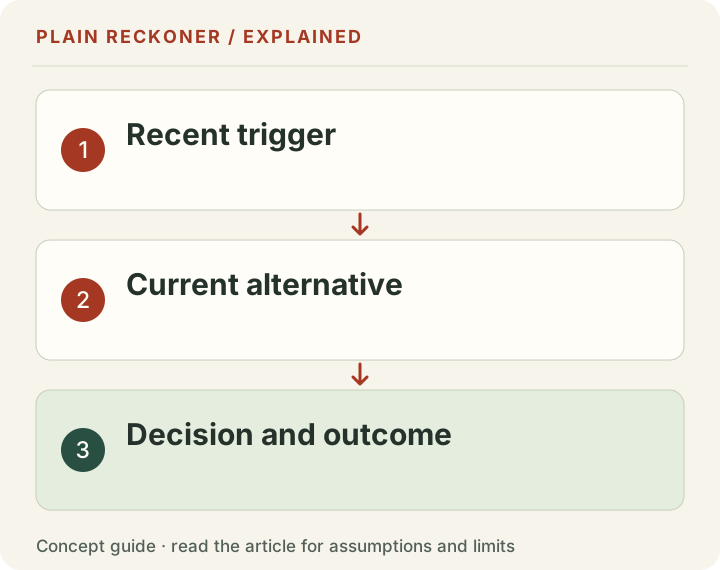
Ask: “What made you start looking then?” This can distinguish a routine need from a deadline, an unexpected failure or a change in circumstances. Follow with “Had you dealt with this before?” if prior experience matters to the writing decision.
Ask what the person needed to have in place by the end. Avoid supplying the desired outcome in the question. “What were you trying to get done?” leaves more room than “Were you trying to save time and money?”
If someone describes a consequence, ask what actually happened on that occasion. Do not escalate an inconvenience into a business disaster. The homepage should not use fear claims that the underlying account does not support.
The trigger can inform the opening context, but one interview does not establish the most common trigger in the market. Record it as a candidate to investigate across other relevant accounts.
Questions about the current approach and alternatives
Ask: “How were you handling this before?” Then ask what, if anything, they considered changing. A spreadsheet, an existing supplier or doing nothing can be relevant alternatives even when no competing product was researched.
Follow with “Which options did you actually look at?” and “How did those options enter the picture?” Keep a real shortlist separate from products the participant has merely heard of. Do not read out your preferred competitor names before they answer.
Ask what worked in the existing approach as well as what did not. A familiar manual process may be adequate or cheaper for the customer's situation. A useful message should explain a relevant tradeoff rather than pretend every alternative is useless.
These answers can inform positioning, but they do not create a complete market analysis. Our positioning-versus-value guide explains how to keep the competitive context separate from a public tagline or one-line description.
Questions about the decision and missing information
Ask: “What did you need to know before taking the next step?” Follow with where they looked and what remained unclear. This can reveal information the homepage should make easier to find, such as coverage, price basis, compatibility or the process after an enquiry.
Ask: “Was there a point where you paused or changed direction?” Invite the person to describe that moment. Do not assume that a pause proves distrust, price sensitivity or a confusing button. The participant's explanation may point to a different issue.
Ask what they ultimately did and why, while allowing more than one reason. A person can choose a provider because of availability and an existing relationship, not because its headline was more persuasive. Do not force every account into a copywriting explanation.
Avoid asking only what would make them buy in the future. A hypothetical preference can suggest a question, but it is not the same as a commitment, a completed purchase or an observed choice under real conditions.
Ask about language without manufacturing a quote
Listen for how people name the task, product and next step. Ask what an unfamiliar term means to them rather than assuming the team shares their definition. Preserve the wording accurately when it is relevant and appropriate to keep.
Do not ask participants to write your slogan. They may describe the situation clearly without being able to produce suitable homepage copy. Translating the account into a useful draft is the team's responsibility.
A phrase heard once is not automatically the best heading. It may be personal, ambiguous or unsuitable outside the conversation. Check meaning across other evidence and test the resulting draft with relevant readers.
Never combine several responses into a fabricated direct quotation. You can write an explicitly labeled summary or a new example, but it must not appear to be one customer's actual words. Permission and accurate attribution still matter when the wording is appealing.
Use follow-ups without leading the answer
“When you said that, what did you mean?” can clarify interpretation. “Can you tell me more about that occasion?” can add context. These follow-ups work because they refer to the participant's account rather than insert a theory for them to confirm.
Replace “Was the form too long?” with “What happened when you tried to contact them?” if the form length has not been raised. The first question can steer attention to the team's suspected issue before the person describes their experience.
Allow silence and uncertainty. Filling every pause with an explanation gives the participant less space to remember or correct the account. A polite agreement after a long sales pitch is not strong evidence about the original problem.
Pilot the guide with a colleague to find confusing wording, then revise it. That pilot checks the interview structure; a colleague is not automatically a substitute for a relevant customer in the actual research.
Keep observations separate from interpretations
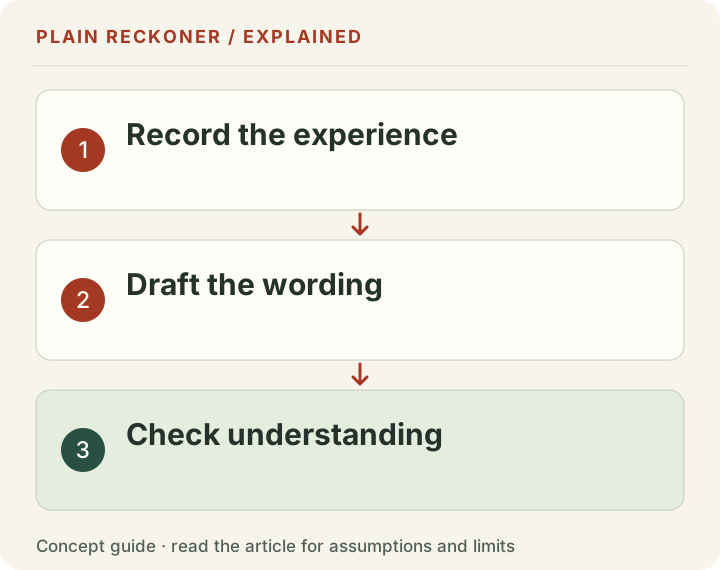
Use a simple note table with participant code, context, reported event, relevant wording, interpretation and unresolved question. These columns prevent a summary from quietly becoming more certain than the underlying account.
The GOV.UK research-analysis guidance distinguishes observations, findings and actions. A practical application is to preserve what was said before deciding what it means or what the page should change.
For example, “the participant asked whether the quote included materials” is an observation if that happened in the session. “Customers distrust our pricing” is a broader interpretation that needs more support. “Add the quote's actual inclusions” is a proposed action, not an observed outcome.
Review interpretations with someone else where practical. Disagreement can identify an ambiguous note or a missing follow-up. The goal is not to vote a preferred message into existence, but to make the reasoning traceable.
Work through an original evidence-to-copy example
Imagine a demonstration account in which a studio owner describes checking three services but being unable to tell whether monthly bookkeeping includes preparing records for an external accountant. This is an illustrative response, not a conversation collected by Plain Reckoner.
The bounded insight is that this participant's decision involved scope clarity. It does not establish that every studio owner has the same concern or that adding one sentence will increase enquiries.
A proposed copy action is to state the actual service scope plainly, if the business can deliver it. If that work is excluded, the page should say so rather than promise inclusion because the interview made it sound attractive.
The next test can show the revised explanation to suitable readers and ask what they believe is included. That is a comprehension question. Later, business outcomes can be observed under an appropriate design without treating the interview itself as a conversion experiment.
Look for patterns without hiding exceptions
Group similar observations by task or decision, then preserve differences that matter. A new buyer may need different information from an experienced buyer. A customer who rejected the offer may reveal a limitation existing customers do not mention.
Do not turn several matching accounts into a precise population rate. Report who was recruited and what was heard in that group. Interview frequency is not automatically market prevalence, especially when recruitment was purposeful or convenient.
Keep counterexamples in the analysis. If most participants want a broad overview but one cannot assess an important accessibility requirement, the less frequent issue may still be serious. Importance depends on consequences and service obligations, not only count.
If the pattern remains unclear, choose a follow-up question rather than invent a clean theme. An unresolved finding can still improve the next round of research or narrow the audience the team should study.
Move into drafting without claiming the research is finished
Create a short working brief: audience, actual task, reported alternatives, information needed, supported offer and unknowns. Use the Offer Builder to turn that brief into editable wording and the Homepage Planner to organize the explanation.
Those tools do not automatically transcribe interviews, recruit participants or verify the conclusions. Keep your research records appropriately outside the public draft and enter only the information the writing task needs.
Use the Test Planner to record the next question. Once a draft exists, run a separate Reader Check to investigate what people understood. Avoid teaching the intended answers before that check.
The useful sequence is evidence, hypothesis, draft and another check. Discovery interviews help the team write about real circumstances instead of imagined customer needs. They do not remove uncertainty, but they make the next copy decision more specific and more honest.
Before sharing a research summary, check every quotation against the notes and remove unnecessary identifiers. State what remains unknown beside the proposed action. The team should be able to disagree with the interpretation without losing access to the underlying observation.