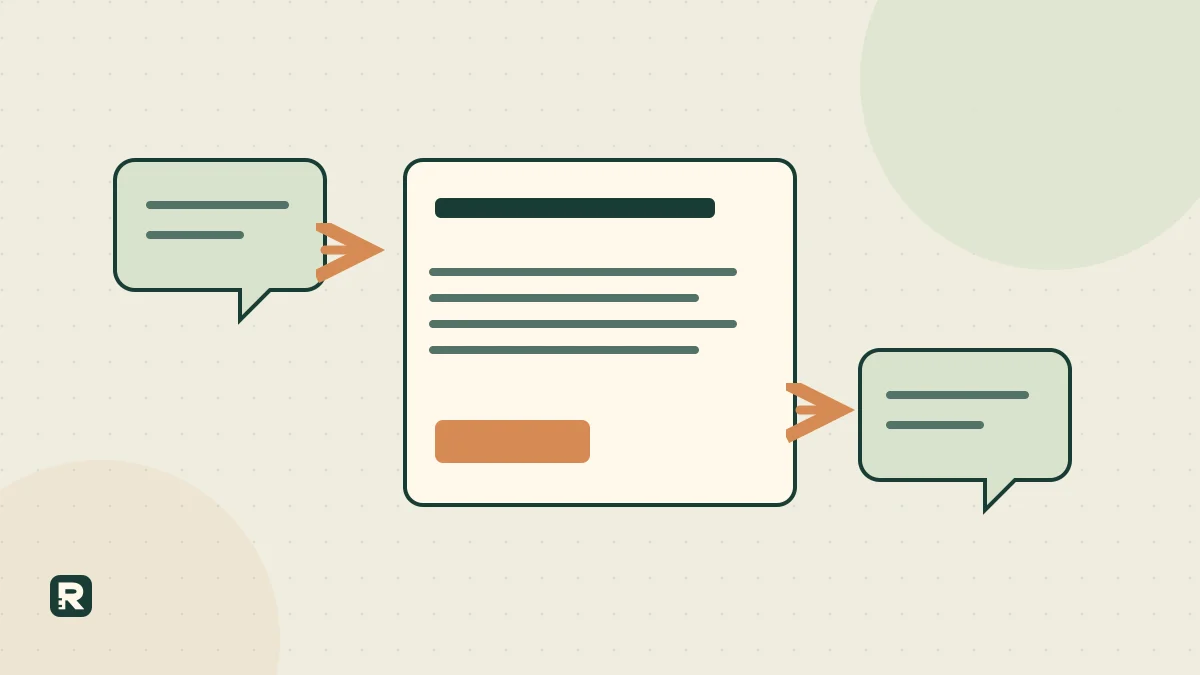
Show your page to someone who could use the offer. Ask what is offered, who it is for and what they expect to happen next. Record the answer before explaining your intention. That simple sequence can reveal a mismatch that another internal design discussion misses.
The purpose is to learn what actual readers understood. It is not to collect compliments, ask people to approve the team's favorite heading or pretend that a few answers predict sales. A useful misunderstanding is evidence you can act on.
The free Reader Check helps a facilitator record responses against a saved draft. You recruit your own readers; the tool is not a participant panel and does not supply real customers automatically. This guide explains how to run the exercise responsibly and interpret the result.
Choose one question the test can answer
A broad question such as “Is our website good?” is difficult to investigate. A narrower question is whether likely readers can identify the service from the first screen, understand who it serves or predict what a contact action does.
Write the intended meaning before showing the page. For an original repair-service example, the expected interpretation could be bike repairs in a named area, with an enquiry followed by confirmation of suitable appointments. Those are separate elements a response might or might not contain.
Do not use the exercise to answer a different question afterward. Understanding an offer is not proof of willingness to pay. Remembering a button is not proof that a visitor could complete the form. Those tasks require their own observations.
A focused question also helps choose the material. If the issue concerns the first-screen explanation, test that screen. If it concerns completing a booking, a static screenshot alone is insufficient; the reader needs to interact with the relevant journey.
Choose brief exposure or a task deliberately
A brief-exposure test asks what someone notices or recalls after viewing material for a limited time. Lyssna's five-second testing page describes this established approach and follow-up questions. Five seconds is a research setting, not a universal biological attention limit.
Use a duration that matches the question and keep it consistent within a comparison. A complex professional-service page may require a longer reading task. A reader using assistive technology may need a different accessible method rather than being forced into a visual timing exercise.
A task test instead asks the person to achieve a realistic goal, such as finding whether the business covers their area and locating the next step. The GOV.UK moderated-testing guidance describes observing participants attempt tasks and explain their thinking.
These methods can complement each other, but their results should remain distinct. Brief recall describes what was retained under the exposure conditions. Task completion describes what the participant did in the tested journey. Neither automatically measures commercial value.
Recruit people with relevant circumstances
Start with the kind of person who might actually face the problem. A team selling to freelance designers should not assume that any available colleague represents that audience. Relevant experience and unfamiliarity with the business can both matter.
Friends and colleagues can still provide useful feedback, but record that relationship. Someone who already knows the offer may fill in missing details without noticing. A person who wants to be encouraging may hesitate to describe confusion.
Write down how participants were recruited and what makes them relevant. Do not call a convenience group representative merely because everyone completed the test. A paid panel also needs suitable screening; payment alone does not make the sample match the audience.
Include accessibility needs when they are relevant to the service. A page that works only for a narrow set of devices or reading conditions has not been validated for everyone. Adapt the method so participants can take part without changing the question into a test of their abilities.
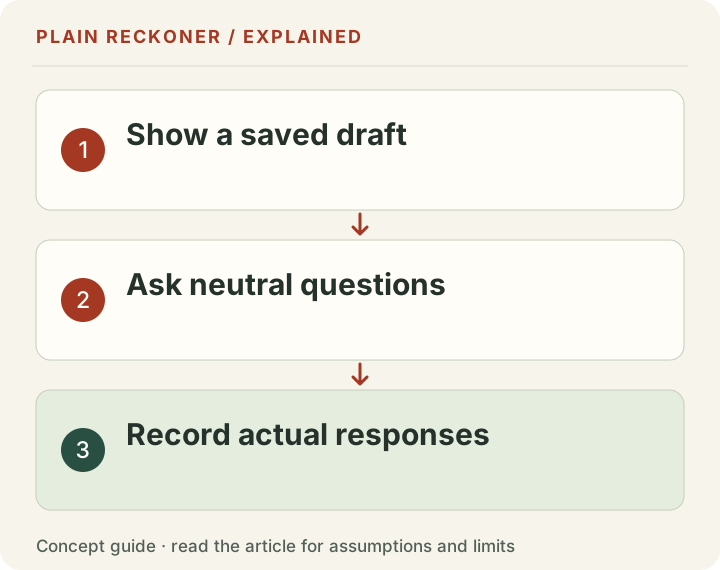
Explain participation and protect the responses
Tell participants who is conducting the exercise, what they will do, what will be recorded and how the results will be used. Make participation voluntary. Ask separately about recording or public quotation rather than treating agreement to answer a question as permission for every later use.
The GOV.UK informed-consent guidance provides a practical account of this process. It is guidance for its context, not a complete legal determination for every business or country. Use appropriate advice where the data or setting requires it.
Avoid collecting details the research does not need. Participant codes can often replace names in the working response table. Keep contact or consent records separately where appropriate, and decide how long information will be retained.
Do not paste sensitive customer information into a public draft or demonstration. Before exporting notes, review free-text answers for personal details. A helpful quotation can remain useful after identifying information is removed, provided that the editing does not change its meaning.
Prepare the material before the session
Save the exact version being tested. Include the heading, explanation and action in the context the participant will encounter. A cropped heading can produce a different response from a full mobile first screen, so label the material accurately.
Check that the text is legible and that loading or animation does not consume the intended exposure period. If the browser tab loses visibility or the participant is interrupted, record that condition rather than pretending the timing remained equivalent.
Do not show the intended answers beside the material. A facilitator's notes and scoring rubric should remain separate from the participant view. Otherwise, the exercise can become a memory test of supplied answers rather than a test of the page.
For comparisons, prepare versions that address a real uncertainty. Keep the rest of the context stable where practical. If the design, price and offer all change, the responses cannot isolate the effect of the headline alone.
Ask neutral questions in a useful order
Begin with an open question such as “What do you think this business offers?” Then ask who the offer seems intended for and what the person would expect to happen next. Give them room to say they do not know.
Avoid leading questions such as “Did you notice our fast repair booking?” That supplies the desired message and invites agreement. A participant who says yes after hearing the explanation has not demonstrated that the page communicated it independently.
Ask follow-up questions about the person's own words. “What on the page gave you that impression?” can connect an interpretation to a specific element. Avoid arguing with an answer or correcting it before the initial response is recorded.
Ask preference questions later if they are useful. “Which do you like?” is different from “What does this mean?” A visually preferred version can still communicate the wrong product or commitment.
Use a rubric rather than an unexplained clarity score
Define what counts as a match before reviewing the answers. For example, a response might correctly identify the service, partly identify the audience and misunderstand the next action. Preserve those separate outcomes rather than hiding them in one decorative percentage.
An explicit rubric can allow matched, partial, mismatched and unclear responses. Write short definitions. A partial answer should have a consistent meaning across participants, not become a convenient category for whichever version the team prefers.
Keep the verbatim response alongside the coded interpretation. That lets another reviewer understand the judgment. If two reviewers disagree, record the uncertainty and resolve the rubric rather than silently selecting the more favorable score.
Do not describe the resulting count as scientifically validated customer clarity. It is a summary of coded responses from a particular group under stated conditions. The rubric makes the reasoning inspectable; it does not remove sampling or measurement limitations.
Work through an original response example
Suppose the draft describes a bookkeeping service for freelance designers. In a chosen demonstration, one reader answers “An app that helps anyone make a household budget.” This is not an actual collected response; it illustrates how to inspect a mismatch.
The reader has misunderstood both the service category and the audience. Instead of concluding that the whole design failed, examine which words or images suggested an app or personal budgeting. A phrase such as “your money dashboard” might be one possibility to investigate, but the example alone does not establish the cause.
A revision could name monthly bookkeeping and freelance designers directly. The next test should use new or appropriately managed participants because someone who has already heard the intended answer may remember the explanation rather than interpret the revised page independently.
Now suppose another reader identifies the service correctly but expects an instant price after clicking. If the action actually requests a later conversation, revise that expectation separately. The useful change is specific: clarify the commitment instead of merely making the button brighter.
Count responses without overstating precision
If four of six recruited readers identify the offer, report four of six in this group. A percentage can accompany the count, but it should not imply that the same share applies to all potential customers. Recruitment, prior knowledge and test conditions still matter.
Do not count an empty record as a completed response. Keep interruptions, withdrawals and technical failures distinguishable from a participant saying they did not understand. The reasons for missing data can affect interpretation.
If different versions receive different participants, inspect whether the groups are comparable before treating their counts as a contest. A convenience allocation can reveal useful misunderstandings without establishing a causal difference in comprehension rates.
Small samples can identify a concrete problem, such as several readers expecting payment from a button intended to open a free example. They usually cannot establish a precise ranking between two close response rates. Let the strength of the conclusion match the evidence.
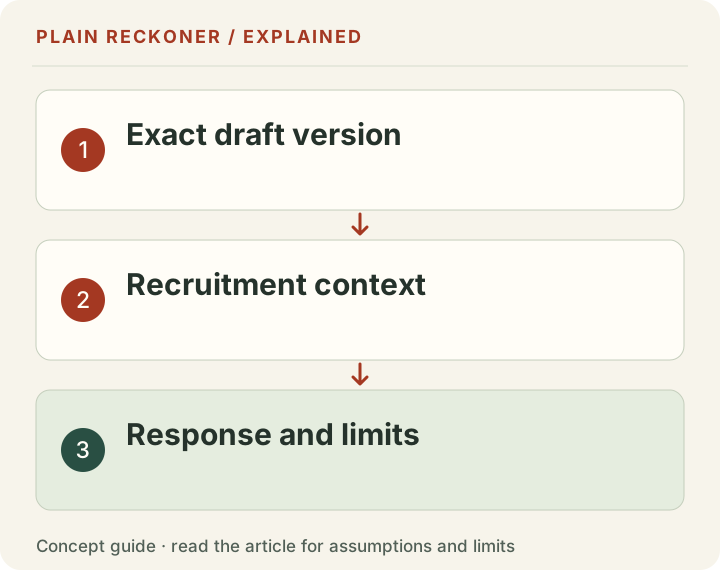
Turn observations into a specific revision
Group misunderstandings by the decision they affect: what is sold, who it serves, what evidence supports it or what happens next. Prioritize issues that prevent a suitable reader from taking an informed step.
Do not rewrite every sentence because one person disliked a word. Consider whether the response reveals a plausible issue for the intended audience and whether other evidence supports it. A single serious task failure can matter, but it needs description rather than an inflated frequency claim.
Save the proposed change and the observation that motivated it. This creates a useful revision record for the team. It also prevents later discussions from turning into a contest between personal preferences detached from what readers actually said.
The Offer Builder can help revise the core explanation, while the Homepage Planner can organize supporting context. Keep old responses attached to the draft participants actually saw rather than moving them onto the newest wording.
Apply book ideas without treating them as customer answers
Donald Miller's Building a StoryBrand 2.0 offers a customer-centered messaging framework. It can help a team ask whether its communication addresses a real problem and a clear next step. It does not supply the responses your actual readers will give.
A framework-based critique and a reader observation are different evidence types. The first can suggest a hypothesis; the second can show what a particular participant understood. AI-generated feedback is another type again and should never be labeled as an interview with a real customer.
Keep all three distinct if you use them. A simulated objection can be useful preparation, but it is not a quotation, a recruited participant or a measured prevalence. Do not fill an empty response table with plausible generated opinions to make the research look complete.
The practical advantage of the test is that it can disagree with the team's preferred framework or draft. Preserve that possibility. A method that only confirms what the business already wants to believe is not helping the decision.
Check the next task after comprehension
Once the offer is understood, ask whether the reader can complete the relevant next step. A clear heading does not prove the form works, the product is suitable or the price is acceptable. Those are additional questions.
Observe the journey with a realistic goal. Do not tell the participant which navigation item to click if finding it is part of the task. Record where they hesitate, what they expect and whether the destination matches the action's promise.
Business results need their own definitions and observation periods. A better explanation may reduce unsuitable enquiries, increase suitable ones or make little difference to demand. Do not translate a reader-check improvement into a guaranteed revenue increase.
Use the Test Planner to decide what to investigate next. The valuable outcome is a clear record: the draft, the people and conditions involved, what they understood, what remains uncertain and what specific change deserves another check.
Share the finding without losing the limits
A useful internal summary includes the tested question, draft version, recruitment source, response counts and recurring misunderstandings. Add the relevant quotations with permission and appropriate redaction. Separate the observation from the team's proposed explanation.
If you publish a case study later, preserve those details and explain any other changes made during the period. Do not turn a small formative exercise into a claim that all customers understood the page or that a new heading caused a revenue result. The bounded finding is still valuable: it shows a specific problem, a reasoned response and a transparent next check. That is a stronger basis for improvement than an impressive score whose inputs nobody can inspect.
Message testing is not a vote for the nicest headline
For message testing, show the exact draft before explaining it. Ask the reader what is being offered, who it is for and what they expect the next action to do. Record their own words. ‘I like it’ does not tell you whether they understood it. A reader who knows your business already may fill in gaps that a new visitor cannot. Note that relationship beside the answer.
A short customer interview template can use three prompts: ‘What do you think this business does?’, ‘What would you expect after clicking this button?’ and ‘What would you need to know before taking that step?’ Follow up on an unclear answer without teaching the intended response. These prompts help you learn about understanding; they do not establish market size, willingness to pay or a conversion lift.
Save the draft and the answers together in the reader check. When you change the page, start a new version instead of combining responses to different wording. Keep personal or sensitive details out of notes you later share with an AI chat.