Start with what the customer is trying to do. Then explain the specific help your business offers. A visitor should not need to read your company history before finding out whether you can solve the problem that brought them to the page.
Making the customer the hero is a useful writing idea, not a requirement to tell an elaborate story or call visitors heroes. In practice, it means giving their task priority while showing why your help is credible and what they can do next.
Use the Offer Builder to draft that relationship. Then organize the page in the Homepage Planner. The original examples below help you make those decisions before you work on the visual page in the page editor.
What customer-as-hero positioning actually changes
Compare two original opening lines for a repair service. “We are an award-winning company passionate about excellence” describes the business. “Get your commuter bike checked before the next working week” addresses a customer task, although the timing must match what the business can deliver.
Neither line proves that a service is good. The difference is the entry point. The second helps a relevant person recognize why they might continue reading. The business can then explain its service, supported credentials, practical process and real availability.
Company information still matters when it resolves uncertainty. A genuine qualification may help establish suitability. A clear service area can prevent wasted enquiries. An established operating history can be relevant if accurately described. Those facts should help the reader assess the offer rather than become a wall of self-congratulation.
The edit is therefore about priority and relevance. It is not a mechanical ban on the words we or our. A page full of you can still be vague, manipulative or untrue.
Use the StoryBrand idea without promising its commercial results
Donald Miller's Building a StoryBrand 2.0 develops a customer-centered approach in which the business helps the customer move toward a goal. Both the original and updated editions distinguish the customer's role from the business's helping role.
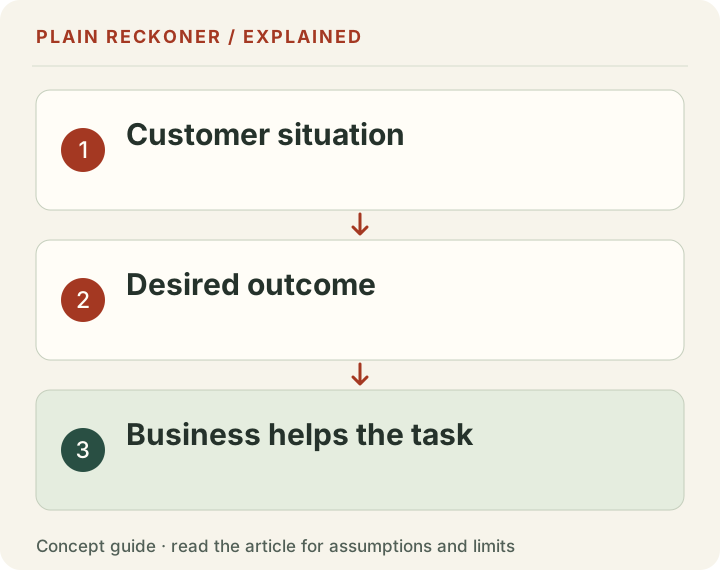
The useful application is to connect a recognizable problem, a credible form of help and a clear next action. It does not require copying the book's worksheets or forcing every business into the same sentence. The terminology supports a draft; it does not replace customer evidence.
Miller's commercial examples and testimonials are author- or customer-reported accounts. They do not establish the revenue effect of your proposed rewrite. A clearer message can still fail commercially because of unsuitable pricing, insufficient demand, poor delivery or the wrong audience.
Plain Reckoner is applying and testing messaging ideas independently. Referencing a book does not imply its author endorses the website, the tools or your business. Keep that distinction clear when presenting your own source list or recommendations.
Choose a goal the customer can recognize
Start with the situation, not an imagined emotional transformation. A freelance designer may need bookkeeping records ready for review. A tenant may need storage that fits a small room. A store manager may need to identify which stock can actually be sold.
Write down who encounters the situation, when it happens and what completing the task would look like. “People who want a better life” gives the draft little direction. “Freelancers preparing records for their accountant” identifies a more concrete job, provided that audience fits the real service.
The GOV.UK user-needs guidance recommends investigating what people are trying to achieve and treating unsupported opinions as assumptions. Its public-service context differs from a commercial business, but that research discipline transfers well.
Ask about actual recent situations. What did the person try, what blocked them and what happened next? A claimed need should not come solely from the founder's preferred marketing language.
Name the problem without manufacturing fear
A practical problem can be described plainly: records are scattered, appointments are difficult to compare or an order's status is unclear. Those statements still need to match the audience's circumstances. Do not declare that every visitor is overwhelmed or failing because the copy needs more drama.
Separate an observed customer statement from an interpretation. If one interviewee says late approvals are frustrating, record it as that person's response. It is not permission to claim that every design team is losing clients because of approvals.
Avoid escalating the stakes beyond the evidence. “See which approvals are outstanding” can explain a useful tool. “Stop your business from collapsing” makes a much larger claim and can exploit anxiety without helping the decision.
A strong message makes the task understandable and relevant. It should not depend on making the reader feel incompetent. The customer can be capable and still benefit from specialist help or a simpler process.
Define the business's contribution precisely
The business needs a clear role too. Say what it does, what it returns and what the customer must still do. A bookkeeping service may organize records and prepare agreed reports; it should not imply that it controls every financial or tax outcome.
For software, distinguish a supported capability from an aspirational benefit. A shared approval list can show outstanding items. If it does not send reminders, contact clients or verify approval authority, the page should not imply that those jobs happen automatically.
For a store, explain the product, suitability and relevant limits. A container can fit a specified space, but it cannot guarantee that every room becomes organized. Measurements and use instructions may be more useful proof than a broad lifestyle promise.
This precision strengthens the helping role. The visitor can understand what the business contributes and decide whether that contribution is sufficient. Unclear boundaries create more uncertainty even when the headline sounds confident.
Demonstrate competence with relevant proof
Competence is not established by calling the team experts. Show evidence connected to the task: a genuine work sample, a relevant credential, a transparent method or a permissioned account of actual customer work. Make the claim's scope clear.
If customer results are unavailable, show a labeled example output. An example repair assessment can explain the service without pretending to be a completed client's case. A sample report can demonstrate structure without inventing a client's revenue or testimonial.
Do not borrow logos from sources and display them as clients. A citation to an organization means it supplied information, not that it hired or endorsed the business. Awards and certifications should identify what was actually awarded and to whom.
Keep proof close to the uncertainty it resolves. A genuine qualification can support a competence claim. It does not automatically establish low prices, guaranteed savings or a universal success rate.
Original example: a local service
Company-first draft: “Our talented team delivers superior storage solutions through years of excellence.” The reader still needs to know what is sold and whether it suits their space.
Customer-task draft: “Fitted bedroom storage for awkward corners and small rooms.” Supporting copy can explain measurement, design, materials, installation coverage and what is included in the quote. The main action could be “Ask about a measurement visit” if that describes the actual next step.
The business's helping role becomes concrete: measure the space, propose a design and supply the agreed installation. Proof might include accurately captioned completed work with permission, material details and real qualifications where relevant.
The draft should not promise more usable space in every property or a delivery date that has not been checked. A suitable customer needs a realistic route to an answer, not a guarantee created by a headline.
Original example: an online shop
Company-first draft: “We are redefining everyday excellence with our premium collection.” A more useful opening for a chosen example is “Refillable cleaning bottles and refills for small homes.” It identifies the product and context without requiring the visitor to decode a philosophy.
The helping role is to make the appropriate product easy to select and use. Supporting information should explain sizes, compatibility, ingredients or materials where relevant, delivery conditions and what the starter kit includes.
Avoid unsupported environmental or safety labels. Calling an offer customer-centered does not relax the standard for factual claims. A customer trying to compare materials needs specific evidence, not just comforting language.
A relevant action might be “Compare starter kits,” with a separate refill route for existing customers. The page respects two different tasks instead of forcing everyone through the same promotional journey.
Original example: a software product
Company-first draft: “The innovative platform for next-generation collaboration.” Customer-task draft: “See which client approvals are still outstanding.” The supporting line can name the shared list, owners and status fields the product actually provides.
A working sample can demonstrate the result. Label its entries as examples and avoid including personal information. The customer can inspect whether the workflow resembles the task they need help with.
The product remains the helper. It organizes information supplied by the team; it does not guarantee that clients respond, projects finish on time or disputes disappear. Those outcomes depend on factors outside the interface.
A suitable action might be “View a sample approval list.” If the destination instead asks for a sales call, change the label or provide the promised sample. A coherent helping role includes keeping the next-step promise.
Audit the page section by section
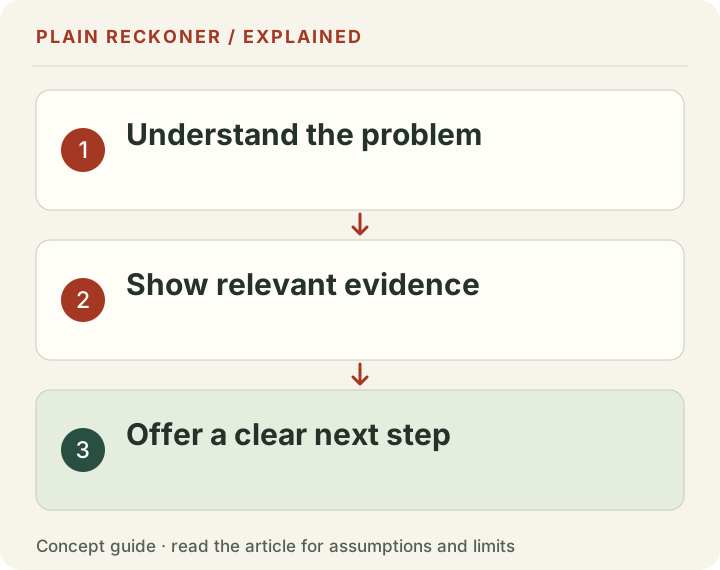
For each section, write the customer question it answers. The first screen may establish relevance. The product section may explain suitability. The process section may remove uncertainty about commitment. Proof may help assess competence.
Keep the company story where it adds useful context, such as a relevant reason for developing the service. Remove details that require effort without helping the visitor's decision. A long history is not automatically bad, but it should not block the primary task.
Use headings that communicate those jobs. The W3C headings guidance explains how headings support organization and navigation. A page's visual hierarchy should also exist in its semantic structure, rather than relying only on large decorative text.
Check the sequence on mobile. A supporting proof card placed beside a claim on desktop may appear much later when stacked. The relationship should remain understandable without requiring the reader to remember a distant heading.
Carry the message into a visual draft carefully
Use the Homepage Planner to organize offer, proof, process and next action. Then use the page editor to work on the page draft. A visual preview helps inspect hierarchy; it does not establish that the underlying message is understood.
Keep essential copy as actual readable text. Do not bake the entire offer into an image or hide necessary conditions in an animation. Consider long labels, zoom, keyboard navigation and reduced-motion preferences while shaping the design.
A useful illustration can show the product or task without impersonating a customer result. Avoid images that suggest a service, team or item the business does not actually provide. If an image is illustrative, make its context clear.
The customer-centered structure should survive ordinary conditions: a narrow screen, a slow connection or someone scanning only headings. Decoration should reinforce meaning rather than become a prerequisite for understanding it.
Test whether readers see the intended relationship
Show the draft to relevant people who have not heard your explanatory speech. Ask what is offered, who it serves and what they expect the business to do. Record their words before correcting a misunderstanding.
The GOV.UK usability-testing guidance describes observing people attempt specific tasks. A realistic task can reveal whether the page helps a visitor assess fit and take the next step, beyond whether they like the wording.
Use the Reader Check to organize actual responses. It does not provide a customer panel or turn simulated opinions into real observations. Record recruitment and conditions so the team understands what the feedback can support.
A clearer interpretation is not automatically a sales result. If readers understand the offer and decide it is unsuitable, the message may be doing useful work. Keep comprehension, task completion, enquiries and revenue as separate outcomes.
Keep the customer central after the first draft
When a misunderstanding appears, revise the specific relationship. If readers cannot name the product, clarify the category. If they understand the product but expect an unsupported service, explain the boundary. If they do not know what happens after clicking, fix the action and destination together.
Preserve the previous draft and the responses attached to it. A later team member should be able to see why the wording changed. Do not move old observations onto a new version and imply that the updated page was tested when it was not.
Use the Test Planner to choose the next evidence-gathering step. A low-traffic business may learn more from a few carefully recruited task sessions than from declaring a conversion winner after a handful of clicks.
The practical goal is an honest page that helps a suitable customer recognize the task, understand the business's contribution and decide what to do next. That is a useful application of customer-as-hero positioning without turning a writing framework into an unsupported business guarantee.
Before publishing, ask the delivery team to review the draft too. A promise can sound clear to readers while being impossible for the business to fulfil. Confirm service coverage, outputs, required customer inputs and response arrangements. This operational check complements reader feedback: one checks what people understood, while the other checks whether the understood offer matches reality. Both are necessary before promoting the page more widely.
Once your plan is clear, use the free HTML and CSS page editor to build a page from your own words. Edit the code, check the phone layout, and copy it into your website or AI builder. The editor does not publish for you or supply customer evidence. Check the page and action links before sharing it.