
Yesterday’s estimated earnings and this month’s bank deposit are not matching measures. Before calling a change an RPM problem, check which earning stage, date range and traffic unit each report uses.
Google’s homepage earnings documentation separates estimates, balance and recent payments. It also explains that adjustments can affect earnings. This guide is a worked reconciliation, not a report from Plain Reckoner’s private advertising account.
Name the number first
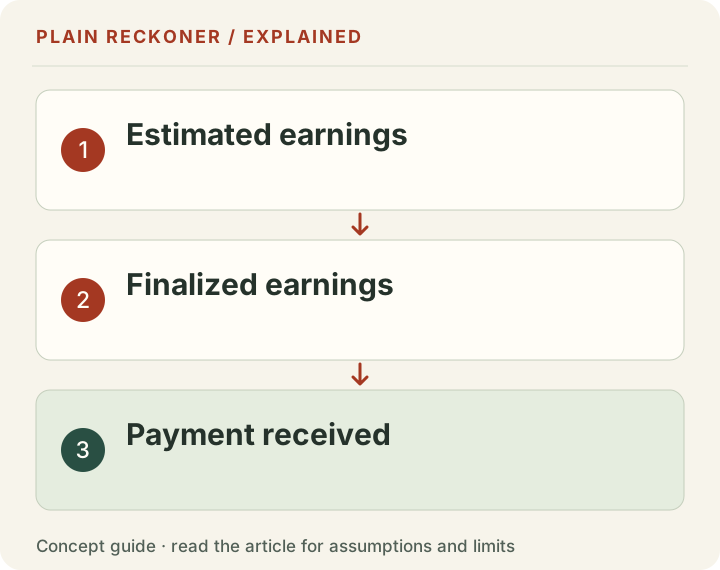
An estimate describes recent reported activity before all finalization. Finalized earnings are posted after the relevant processing. A balance can include money from more than one period and adjustments. A payment is a transfer subject to payment eligibility and timing.
| Number | Useful question |
|---|---|
| Estimated earnings | What is the current estimate for this reporting window? |
| Finalized earnings | What was posted for the relevant period? |
| Current balance | What remains on the payments account after applicable entries? |
| Payment received | What transfer actually arrived, and when? |
Do not add these together as separate sources of income. A payment can settle a balance that already includes the earnings you counted.
Recalculate RPM on the same basis
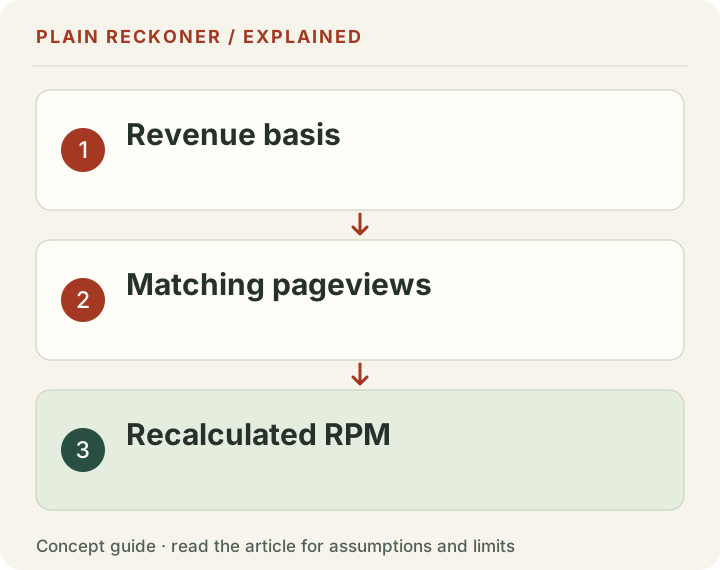
Suppose one reporting period has 100,000 pageviews and an initial earnings estimate of $1,000. The estimate-based page RPM is $10. If finalized earnings for that same period become $960, the corresponding finalized-earnings page RPM is $9.60.
The $40 difference is 4% of the original estimate. That percentage is only this example; it is not a typical adjustment rate or an estimate of invalid traffic. Pageviews are unchanged in the worked calculation.
If you instead divide that $960 by a different month’s pageviews, the apparent RPM change mixes two effects. If you divide by ad impressions instead of pageviews, you have changed the denominator. Use the ad report checker and the RPM versus CPM guide to keep those units clear.
Read the payment entries
Inspect the account’s transactions and any notices. Google describes adjustments associated with invalid impressions or clicks and other possible payment changes. A public tool cannot identify the private reason for an adjustment, and an aggregate difference does not prove a specific traffic source caused it.
Keep the original period totals, the finalized entry and the adjustment description. Do not invent a daily breakdown that the provider does not disclose. If you ask for help, use the provider’s official support channel for sensitive account records.
A payment delay is another question
Google’s steps to getting paid describes verification, payment-method and payout thresholds. Payment availability can also depend on holds and required account tasks. A month below a payout threshold is not automatically a month with zero earnings.
Check your account’s exact status and currency-specific requirements. Do not copy another publisher’s payment timetable or assume that changing the website’s design resolves a payment hold. Site review, identity checks and receiving a transfer are separate processes.
Build a small reconciliation record
Keep one row per earnings period: the traffic denominator and source, estimated earnings, finalized earnings, adjustment entries, and the payment that eventually settles the relevant balance. Record which figures are still provisional. Revisit a completed month before comparing it with another completed month.
For current operating decisions, use the same basis across the periods. The two-period revenue comparison can separate traffic and RPM effects when the inputs refer to comparable windows. It cannot read your private AdSense ledger or replace a payment reconciliation.
Once the stages line up, investigate the actual change. If revenue fell with unchanged pageviews, a lower earnings-based RPM may be real. If only the transfer date moved, that is a cash-timing question. Keeping the distinction saves you from changing content or ads to fix the wrong problem.
Reconcile the balance before using the bank deposit
A payment-account balance can contain earlier unpaid earnings as well as the latest month. A simple chosen ledger shows why the deposit should not automatically become the latest month's revenue.
Suppose the opening unpaid balance is $200. Finalized earnings for the new period add $960. A separately recorded adjustment subtracts $10. A payment then removes $1,000 from the account balance. The closing unpaid amount is $150.
| Chosen ledger entry | Balance change |
|---|---|
| Opening unpaid balance | $200 |
| New finalized earnings | +$960 |
| Separate recorded adjustment | −$10 |
| Payment issued | −$1,000 |
| Closing unpaid balance | $150 |
The example's $1,000 payment is neither the $960 new finalized earnings nor the $950 remaining after that separate adjustment. It settles part of a balance containing multiple entries. The adjustment here is only a chosen ledger item; no cause or typical deduction rate is implied.
Do not subtract a deduction twice. If the finalized earnings number already reflects an adjustment, entering that same reduction again understates the balance. Read the actual account entries and their periods instead of reconstructing them from a remembered estimate.
Estimated and finalized rates are different versions of a period
The earlier $10 and $9.60 page RPMs use the same chosen pageview count and different earnings stages. That isolates one effect. In practice, the reporting periods or timezones may also differ, so the full reconciliation can require more than replacing the numerator.
Google's homepage documentation notes that account reports and billing calculations can use different timezone boundaries. Record the timezone beside the dates. A calendar month beginning at midnight in one zone is not the identical set of hours in another.
This does not mean every large discrepancy is a timezone issue. It gives you a concrete check before making a causal claim. If the difference remains unexplained, keep it unresolved and inspect the official transaction information.
For a consistent time-series analysis, choose a defined earnings stage. Comparing one provisional month with another fully finalized month needs a clear warning. Where possible, repeat the comparison after both periods are complete on the same basis.
A missing payment is not automatically missing earnings
Google's payment timeline separates earned activity, finalization and issuing a payment under the account's conditions. A payment may also take time to reach the receiving institution after issue.
Check the status of the transfer and the account tasks before rewriting a revenue model. A balance that has not met the applicable threshold is a different situation from a failed transfer. A hold is different from a lower finalized amount. The next action depends on which state is actually shown.
Google's threshold documentation lists currency-specific and task-specific thresholds. A payment-method selection threshold is not the same as the threshold for receiving a payment. Follow the account and its current official instructions rather than assume a missing option means the site itself was rejected.
Avoid copying a single universal dollar threshold into every localized guide. Account currencies and requirements differ. The useful information is which threshold applies to the account you are checking and whether its associated task is complete.
Do not infer an invalid-traffic rate from the difference alone
An estimated-to-finalized difference is an observation about two amounts. Its percentage is not, by itself, a measured share of invalid visitors, invalid clicks or invalid impressions. Those denominators would be different even if an adjustment related to invalid activity.
For example, a $40 reduction from a $1,000 estimate is four percent of the estimate. It does not show that four percent of pageviews were invalid. Different interactions can have different earnings amounts, and the report may not provide the required detailed breakdown.
Use the explanation actually supplied in the account and Google's documentation. Do not attribute the change to a specific referral source, country or person without supporting evidence. A public site scan cannot establish that private cause.
At the same time, investigate actual traffic-quality concerns where evidence exists. Review acquisition practices and implementation rather than buy more visits to offset the reported difference. A larger traffic count is not a remedy for a measurement or policy issue.
Keep earned revenue separate from other income streams
A publisher may receive affiliate commissions, sponsorship payments, product sales and display-ad payments in the same bank account. Adding them all into an AdSense RPM numerator makes the rate describe a different business mix.
If you want display page RPM, use the corresponding display revenue and matching pageviews. If you want total business revenue per thousand pageviews, label it as a different measure and explain which streams are included. Neither should silently become the other's benchmark.
Refunds or commission reversals can also occur in later periods. Keep each stream's reporting rules and settlement timing in its own reconciliation. A bank receipt date is useful for cash planning but does not automatically define the activity period for every income source.
The same principle applies to expenses. A transfer received after fees may differ from a gross or estimated revenue figure. State which basis the rate uses and do not subtract the same fee again if it is already netted out.
A useful monthly worksheet has two linked views
The earnings view records the period, reporting timezone, traffic source and count, provisional earnings and finalized earnings. Its purpose is a comparable revenue rate and an explanation of revisions.
The cash view records opening balance, finalized additions, separately applicable adjustments, issued transfers and closing balance. It then matches issued transfers to actual bank receipts. Its purpose is to trace money and timing.
Link those views through the source entries rather than force them into one total. A finalized month may contribute to a later transfer. An opening balance may include prior periods. A receipt can arrive after the issue date. Keeping those links explicit makes the report understandable.
Save an untouched export and put reconciliation notes in a separate sheet. If a later correction changes history, retain the earlier version or the change record. This lets you distinguish a real earnings change from a reporting revision.
Use small checks to catch spreadsheet mistakes
Start with the ledger identity: opening balance plus additions minus deductions and payments equals closing balance. Check signs carefully. A payment reduces the provider balance but increases the receiving bank balance; entering it as a new income item in both views can double-count the same money.
For a percentage adjustment, specify the denominator. The reduction from $1,000 to $960 is four percent of the original estimate. Recovering from $960 back to $1,000 would require about 4.17% of the smaller amount. Those percentages differ because their bases differ, not because money is missing.
For RPM, a positive traffic count and zero earnings yields zero. A zero or missing traffic denominator does not yield a meaningful rate. Positive earnings beside zero reported pageviews should trigger a scope check instead of an infinite value.
Rounding can explain small differences when a displayed rate is multiplied back into a large count. Preserve the original revenue and count for reconciliation; do not expect a two-decimal rate to reconstruct every cent exactly.
Choose the next action from the state you found
If only payment timing changed, update the cash plan and follow the official transfer-status instructions. If earnings were revised, reconcile the period and available adjustment explanation. If traffic and earnings truly changed on matching definitions, investigate the audience, setup and demand with the appropriate reports.
If the account requests identity, address, tax or payment information, complete the authenticated task. Editing a public article does not submit those records. A developer can help verify the site implementation but cannot certify a private account state from the publisher ID alone.
If you ask for help, summarize the issue without sharing sensitive documents: the metric names, periods, currency, observed difference and the task shown. Leave passwords, identity records and banking credentials in official channels.
The benefit of this process is a smaller, clearer problem. “AdSense took my money” may become a timing question, a balance reconciliation or an earnings adjustment requiring official support. Each has a different remedy. Matching the numbers first prevents a content or ad-layout change aimed at the wrong issue.
Example of a misleading month-to-month comparison
Suppose a chosen January activity period earns $300 and the related cash arrives in February. February activity earns $400 and its related cash arrives in March. If you divide the February bank receipt by February traffic, you have paired January's earnings with February's audience.
That result can be calculated, but it is not February's earned page RPM. The mismatch can produce a false drop or rise depending on the traffic pattern. Keep the activity month attached to the earnings before calculating the rate, and keep the receipt month attached to the cash plan.
A further complication is an accumulated balance. A payment can include more than one earnings period if an earlier balance remained unpaid. In that case, no single month's pageview count is a suitable denominator for the entire transfer without a clearly defined broader comparison.
This is not a forecast of Google's exact payment timing for an account. It is a chosen example showing why receipt dates and activity dates need different columns. The actual schedule and eligibility remain subject to the account's official terms and status.
Before publishing a claim about an earnings change, ask whether another reader could identify both the money period and the traffic period from the chart. If not, repair the labels before interpreting the percentage. A clear definition prevents a precise calculation from becoming a misleading business claim.
Preserve the source entry when the matching period remains uncertain.