
A flat sponsorship price can coexist with a changing audience and fewer listed ad opportunities. This historical Cooper Press case compares published asking prices and observed inventory, not booked revenue or the entire newsletter market.
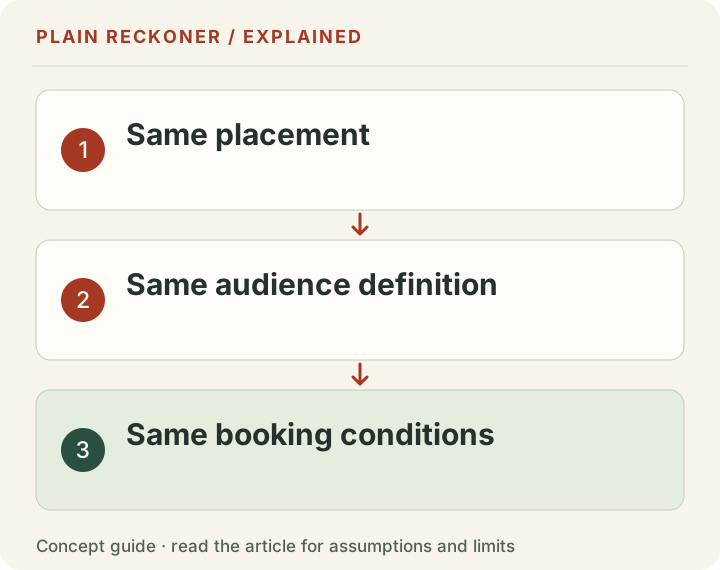
The publisher's Q1 2025 media kit and Q4 2026 media kit make the endpoints checkable. The latter's subscriber figures are labeled August 2026, and its asking prices are valid through the end of December. A quarter label is not a completed-quarter earnings report.
The prices have not moved since Q1 2025
The published asking price for the main slot in one issue, in US dollars:
Swipe or scroll the table horizontally to see every column.
| Newsletter | Q1'21 | Q1'23 | Q1'25 | Q4'26 |
|---|---|---|---|---|
| JavaScript Weekly | 2,900 | 3,520 | 3,680 | 3,680 |
| Frontend Focus | 1,700 | 1,800 | 1,790 | 1,790 |
| Node Weekly | 1,120 | 1,340 | 1,460 | 1,460 |
| Postgres Weekly | 580 | 920 | 1,280 | 1,280 |
| React Status | 720 | 1,100 | 1,265 | 1,265 |
| Ruby Weekly | 970 | 1,220 | 1,220 | 1,220 |
| Golang Weekly | 750 | 1,060 | 1,120 | 1,120 |
JavaScript Weekly's displayed main-slot price rises about 27% between the listed Q1 2021 and Q1 2025 endpoints. Some other titles have decreases between intermediate years. In the saved quarterly series, the seven main-slot asking prices remain at the Q1 2025 levels through the Q4 2026 card; that does not describe negotiated prices or every ad product.
A constant nominal price can lose purchasing power when relevant costs rise. That requires an explicit cost or inflation basis; this case does not measure the publisher's cost inflation or real profit.
The audience shrank underneath the frozen price
Swipe or scroll the table horizontally to see every column.
| Q1 2025 | Q4 2026 | Change | |
|---|---|---|---|
| The 7 newsletters together | 461,876 | 436,662 | −5.5% |
| JavaScript Weekly | 176,998 | 163,202 | −7.8% |
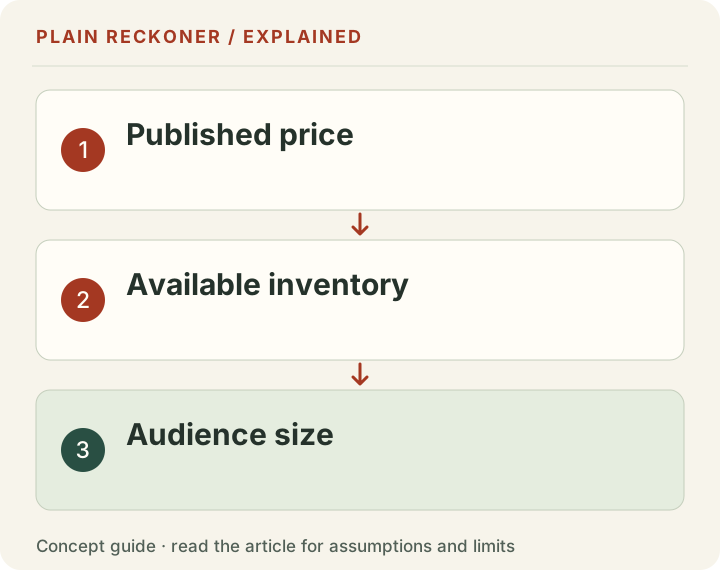
Work out the published price per thousand listed subscribers — not a measured impression CPM — and it drifted up over this period — but only because there were fewer readers to divide by. That arithmetic does not establish delivered impressions, actual sponsor charges or pricing power. It is the same advertised price divided by a smaller listed audience.
Ad slots were cut while the price list was held
Counted from the published back issues:
- JavaScript Weekly: 4 paid slots per issue (2022-24) → 3 (2025-26)
- Golang Weekly: 3 slots → 2, from 2024
- Q3 2026 removed React Status's "Sponsored" slot. The total value of everything they had to sell fell from $17,595 to $16,945.
The observed slot and list-price changes do not establish why the publisher changed the layout or whether placements sold.
The publication list has limits too
The historical publications page observation recorded seven visible titles and six additional title references inside HTML comments. That does not support the earlier claim that twelve publications became seven: those counts do not reconcile, and hidden source text alone does not prove when a publication ended.
A current visible list, a historical archive and a commented template are different evidence. This case does not infer closure dates or motives from the template alone.
The sentence that is not evidence
The publisher's advertising page describes advance reservations and a waiting list. Its visible update label remains October 2021. Repeated wording is not a time series of current bookings.
The statement may still accurately describe the publisher's process. Its age does not prove demand disappeared. It simply cannot tell us how many slots sold this quarter, how long a queue is or what price sponsors actually paid.
What this is and is not
This is one publisher, in one subject area, that happens to publish unusually well. It is not the newsletter market.
The value is the ability to compare a public price series with separately recorded audience and layout information. We do not claim it is the only such series or that it disproves growth across the wider category.
Grade this A, not A★: the figures come from the source and have been checked twice, but a single publisher cannot carry a claim about a whole category, and we are not making one.
Historical-snapshot limitation, 19 October 2026: rate cards are advertised prices, not verified booked revenue; subscriber totals are not delivered impressions. A Q4 rate card can be published before the quarter, so this is not a completed-quarter earnings record. Layout changes and list-price stability do not identify unsold inventory or the publisher’s motives. The underlying August observation has not been re-dated as a current demand study.
Keep the units of newsletter inventory separate
A newsletter can list a main sponsor, a smaller sponsored placement and classifieds. A price per placement per issue is not the same as a price per month, a delivered-impression CPM or a guaranteed reader action.
The current rate card makes its per-issue currency basis visible. Use that exact unit when comparing the saved endpoints. If an agreement covers several issues, bundles titles or includes another service, its effective charge can differ from the card.
A listed opportunity is also not a sold opportunity. Counting the number of paid-style placements in a public issue can show the observed layout. It does not necessarily reveal whether each was booked at full price, discounted, provided as a make-good or part of another arrangement.
Keep these evidence types in separate columns: asking price, available format, observed placement and verified revenue if available. A public record can provide some while leaving others unknown.
Price times all slots is a capacity scenario
The $16,945 sum describes the listed value of the available formats under the stated combination. It is not money collected. Multiplying it by a presumed number of issues and calling the result annual revenue adds assumptions about schedule, fill and realized pricing.
Take a separate chosen example. A publication offers two placements at $500 and $200 per issue. Selling both at those card prices would produce $700 gross sponsorship revenue. Selling only the first would produce $500. Selling both at a combined $600 agreement would produce another result.
The same capacity exists in each scenario, but realized revenue differs. A layout change can alter capacity while the publisher preserves or changes total booked money through other pricing and scheduling decisions. We do not observe those private decisions in this case.
Use capacity arithmetic to understand the offer, not to assert demand. A slot removed from a card may reflect design, reader experience, editorial priorities or commercial choices. The card alone cannot identify which explanation applies.
Subscriber counts are not delivered impressions
A subscriber is a listed audience unit. A delivered email, an open and a click are different events. The rate card's subscriber total does not establish that every address received and read an issue.
For a chosen example, a $1,000 placement in a list with fifty thousand subscribers has a card price of $20 per thousand listed subscribers. If forty thousand copies are delivered, that same charge is $25 per thousand delivered copies. If ten thousand recipients register an open, the charge per thousand recorded opens is $100.
Those denominators are not interchangeable CPMs. The example is not a measured Cooper Press campaign and does not estimate its actual delivery or open behavior. It explains why a calculated audience-price ratio needs its label.
A sponsor evaluating a campaign also needs the relevant outcome and attribution definition. Clicks, signups, qualified leads and purchases can differ. A publisher's card can describe the product offered without proving the sponsor's incremental return.
A higher audience-price ratio need not be a price rise
If the advertised price stays constant while the listed audience shrinks, price per thousand listed subscribers rises mechanically. That does not establish the publisher negotiated higher charges or made more revenue.
Conversely, a list can grow while the advertised price stays flat, lowering that ratio without lowering the per-placement price. A single rate can move because its numerator changed, its denominator changed or both.
Keep the original amounts beside the ratio. In this case the source cards support the asking prices and audience labels for their stated dates. They do not turn the ratio into a delivered-impression auction rate.
The same principle applies to public claims about price stability. Stable main-slot prices do not prove every sponsorship format, contract or net receipt stayed unchanged. The finding should remain attached to the specific series measured.
Why one publisher is a case, not the market
Cooper Press serves a particular technical audience with an established portfolio. Its public record is useful because it exposes information often needed for comparison. It cannot represent every newsletter size, language, subject or sales model.
A market-wide claim would need a defined frame and comparable observations across publishers. A handful of visible price pages would still need consistent units, dates and audience measures. A platform's customer base would have its own selection limits.
Do not combine a public rate from one publisher, a modeled revenue estimate from another and a self-reported success story from a third into a supposedly standardized CPM table. Each may be useful for a narrower question, but they are not automatically comparable observations.
This case instead teaches a measurement habit: inspect price, quantity, audience and time separately. That habit can help a publisher evaluate their own business without claiming the entire newsletter category is growing or contracting from one source.
A practical sponsorship review for your own publication
Record the actual offers you sell: format, title, issue date, card price, booked charge and any bundled services. Keep reader-facing and advertiser-facing terms clear. Preserve which inventory remains available and which has been committed.
Then record costs and workload. Editing, sales, design, list growth, delivery and support can change even when the card does not. Gross sponsorship revenue is not the contribution left after those costs.
For a new offer, use explicit fill and realized-price scenarios. Do not assume every listed slot sells at the full asking price. Do not assume a waitlist statement guarantees next quarter's demand. Use actual bookings when they exist and label forecasts separately.
After an issue, compare what was promised with what was delivered using the agreed definitions. Keep any refunds, credits or make-goods in the relevant financial record. A professional report distinguishes the scheduled offer from the completed outcome.
Preserve source versions when comparing quarters
A current PDF may be published ahead of its named quarter and contain audience data from an earlier month. Save the file and its internal labels. The download date, audience observation date and price-validity period are separate facts.
For this editorial review, the Q4 card was reopened and its rate table inspected directly. That confirms the endpoint table as currently published. It does not independently re-count every historical issue or refresh the August observation as a current sell-through study.
If a future card changes a number, record the new source version and explain which field changed. Do not silently replace older values and leave the previous chart caption claiming an unchanged series.
The useful end point is a source-backed picture of the offer and its limits. Public price stability and inventory changes are observable facts worth studying. Private booked revenue, demand and motives remain separate questions until evidence supports them.
Test a business plan with incomplete fill
A sponsorship budget should survive realistic uncertainty about sales. Use a chosen example with four issues in a month, each offering the $700 combined capacity described earlier. Full card-price sale of every placement would produce $2,800 before costs.
If only the $500 main placement sells in each issue, the month produces $2,000. If two of those main placements remain unsold, it produces $1,000. The difference is not a change in the advertised $500 rate. It is a change in sold quantity.
Now suppose named monthly production and delivery costs are $1,200. The three scenarios leave $1,600, $800 and negative $200 before other excluded costs. This is not a forecast for a real publisher. It shows why the fill assumption can dominate a business decision even when every visible price stays stable.
Use your own booked history to choose meaningful scenarios. If no bookings exist, preserve that uncertainty rather than present the maximum capacity as expected revenue. A small pilot can test demand without committing the expense implied by a fully sold schedule.
Ask advertisers a specific question
A waiting list statement is broad. A useful commercial conversation asks about the actual format, issue dates, audience definition, availability and terms. Confirm what a reservation means, when payment is due and which outcome reporting will be supplied.
Keep requests factual. A sponsor may value brand awareness while another needs qualified leads; the appropriate success measure differs. Do not promise a sales result the publication has not measured or agreed to guarantee.
For research, those conversations can add context but should not be mixed silently with the historical public-card dataset. A private quote, a public asking price and a completed campaign remain different observations with different permission and disclosure considerations.
A careful case study keeps all of them useful by naming what each one establishes. That is the lesson to carry into a newsletter business, a publisher dashboard or another public-data product: a visible price is one part of the operating picture, not the whole business.
Retain the issue dates and source versions when sharing any calculation so another reader can distinguish the observation from the scenario.