
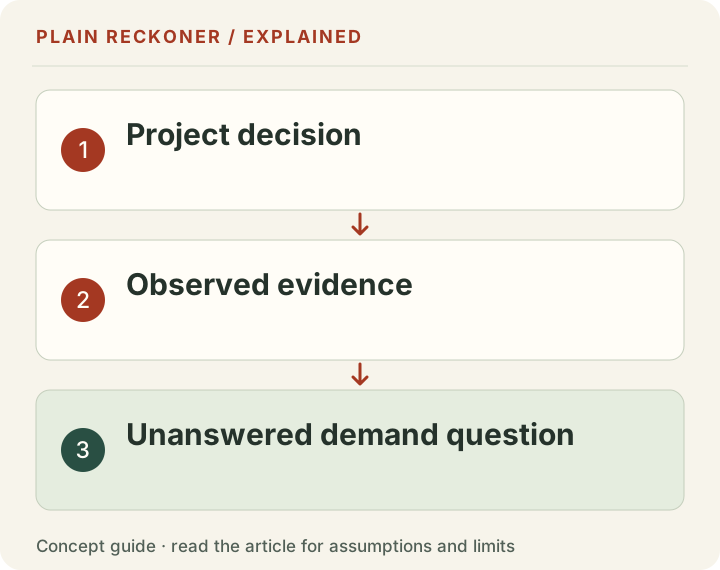
A gap in search results is not proof that customers need a new product. It may indicate a useful unmet task, a different name for an existing solution, a difficult data problem or very little demand. The useful next step is to investigate the decision behind the apparent gap.
In a historical internal review, this project screened nine ideas and rejected all nine under its criteria. During the same broad period, it built three measurement tools for immediate internal tasks. Those tools were usable for those tasks. That is a retrospective observation, not a success rate for two universal ways of building a business.
This guide explains what the experience can teach without claiming that rejected ideas could never work, internal tools prove paying demand or no competing solutions existed anywhere.
Keep a project decision separate from a market verdict
An idea can be unsuitable for one project because of limited time, required permissions, acquisition cost or the team's skills. Another operator with different resources might make a different decision. Rejection under a set of constraints is not proof that the market itself is impossible.
Write the actual reason for stopping. “We could not collect this field reliably within our budget” is more informative than “the market is dead.” “The user task was not sufficiently clear” is different from “there are no customers.”
The historical count of nine belongs to a particular selected set. The ideas were not randomly drawn from every possible opportunity, and the criteria evolved as the project learned. A zero-retention count cannot be used as a general probability that market scanning fails.
The same caution applies to the three internal tools. Completing a useful calculation shows practical value for an identified task. It does not establish a commercial market, a defensible business or the absence of existing products.
Begin with a decision someone actually makes
A concrete problem provides a stronger starting point than an empty keyword list. Someone may need to compare supplier offers, decide which website message to test or distinguish traffic changes from rate changes. The decision tells you what an answer must help them do.
Ask when the task last occurred and how it was handled. What information was missing? What happened because it was missing? A detailed account of a real situation is more informative than a broad statement that better data would be nice.
The GOV.UK guidance on learning user needs recommends investigating what people are trying to do and treating unsupported opinions as assumptions. That is useful here even though a commercial small business differs from a public service.
Do not convert one person's frustration into a market size. It can justify an exploratory prototype or more interviews. The next question is who else faces a similar task and whether the same help is suitable for them.
Search is a discovery tool, not a demand measurement by itself
Search results can reveal competitors, terminology, related questions and existing materials. They can help avoid building a duplicate from ignorance. Their absence can also be misleading because a useful substitute may be distributed privately or described differently.
Record the exact query, date, language and method. A list returned by a search service is a discovery sample, not automatically a measured Google ranking, keyword volume or market-share table. Keep those evidence types distinct.
A promising phrase may be too broad or ambiguous for the proposed task. A business-description query can return personal bios or jokes rather than business messaging. Inspect whether the result set represents the intended audience before drawing a product conclusion.
Do not label a competitor dominant merely because it appears twice in one sample. More systematic repeated observations would be needed for a stronger visibility claim, and visibility still would not establish its revenue or customer satisfaction.
Existing competition can clarify the task
Finding a competitor does not automatically kill an idea. It can show that someone offers a related solution and reveal the expectations a new product must meet. Inspect the actual workflow rather than stopping at a homepage promise.
Compare the task, input burden, output, limits, access requirements and next step. A free generator, a paid research panel and a manual consultancy can overlap in topic while serving different needs. Do not collapse them into one competitor category solely because they use similar keywords.
A useful difference should matter to a user. A slightly different color palette or a larger count of vaguely related tools may not solve the missing task. A connected draft-to-feedback workflow might be useful, but that usefulness should be tested rather than declared exclusive.
Preserve competitors' strengths in the review. The point is not to produce a table where every other product loses. A fair comparison helps the project decide what to build, what to integrate and what not to attempt.
An inactive product invites questions, not a single causal story
The old note treated stopped series and smaller websites as evidence that an area did not pay. That inference was too strong. A product can stop because of ownership, staffing, strategy, distribution or many other factors besides market economics.
If the operator publishes a reason, cite it with its scope. If not, describe the observable state: the latest available edition, changed route or current catalogue. Do not turn an inactive page into proof that every capable operator abandoned the task.
Historical snapshots also need compatible definitions. A sitemap can omit pages without proving that all removed URLs disappeared from the business. A site migration can change counts. Inspect the relevant behavior before using a shrinkage claim.
The practical question is what the earlier attempt can teach. It may reveal source difficulties, maintenance burden or a different customer segment. Those are hypotheses to investigate, not permission to invent the operator's motives.
Data access and user demand are separate risks
A product can solve a real problem but require information that is not available or reusable under the proposed conditions. Conversely, data can be easy to collect without anyone needing the output. Test both links.
A provider's refusal to publish one field does not prove that no permitted solution exists. A partnership, survey or narrower product may be possible. It does mean the project cannot responsibly promise that field based solely on an unapproved collection method.
The public-data feasibility guide separates reachability, interpretation, permission and maintenance. Those checks should happen early enough to change the scope before a large marketing promise is written.
Keep a decision log for blocked sources. State what was requested, the outcome and the consequence for the product. Avoid treating technical access as a permanent right or treating one unavailable source as proof that the entire task cannot be served.
Internal tools provide a concrete but limited starting advantage
An internal need can make the first task precise. The builder knows which decision is waiting and can tell whether the output helps. That can reduce ambiguity compared with starting from a broad trend.
It also creates blind spots. The builder may have specialist knowledge, private context or a tolerance for complexity that a new user lacks. A tool that works for its author can still be difficult for someone else to use correctly.
Test the workflow with another suitable person. Ask them to supply inputs, interpret the result and identify the next step without receiving a long explanation. Record where they need help. An internal tool becomes a more credible public product when those issues are addressed.
Do not use internal completion as a substitute for willingness to pay or recurring use. It establishes one kind of usefulness. Commercial value, distribution and ongoing maintenance remain separate questions.
Make evidence visible instead of claiming superior rigor
The earlier note argued that a rigor claim could be copied easily. The useful part is that a badge alone does not let a reader reproduce a result. A more practical response is to publish definitions, source dates, assumptions and relevant workings.
The W3C Data on the Web Best Practices discusses provenance, metadata and versioning. These principles help make a dataset understandable and reusable. They do not guarantee that every user or platform will recognize the difference immediately.
Avoid unsupported accusations about competitors' accuracy or funding status. A sampled page with weak sourcing can justify a bounded observation about that page. It cannot establish that every page is false or that an advertising network knowingly approved misinformation.
For your own product, connect each material claim to an inspectable basis. A worked example should be labeled an example. A source quotation should remain attributed. A new measurement should identify what was actually collected and when.
Turn a product idea into a testable statement
Replace “there is a huge gap for better analytics” with a bounded hypothesis. For example: independent service owners preparing a homepage can use a shared draft and reader-response record to identify a misunderstanding they can revise.
That hypothesis identifies an audience, task, proposed help and observable outcome. It still does not prove demand, but it suggests a practical test. You can recruit relevant people, watch the workflow and record whether the output supports the decision.
Keep the outcome separate from praise. A participant saying the idea looks useful is different from completing the task or returning to use it. A free successful task is different from a paid purchase. All can be recorded without pretending they are equivalent.
The Test Planner provides a place for the hypothesis, method, observations and limitations. It cannot generate a real customer result from the business description alone. Supply actual records and leave missing evidence unresolved.
Apply a messaging framework after the offer is grounded
The customer-centered approach in Building a StoryBrand 2.0 can help explain a useful offer. It encourages attention to the customer's problem and next action. It does not create demand simply by fitting an idea into a story.
Before writing the polished promise, check whether the product actually supplies the described output. A clear message for a nonexistent capability is still misleading. A compelling outcome that depends on unverified data should not become the headline.
Use the Offer Builder to make the draft concrete, then check it with actual readers. Keep the source of each claim visible: assumption, external evidence or observed result. A framework can organize the message while the evidence determines what the business can honestly say.
The goal is not to make every idea sound exciting. It is to help a relevant person understand the offer well enough to choose an informed next step.
Choose stopping criteria that fit the project
Decide what would make the next stage worthwhile before gathering results. The criteria might concern task completion, source permission, review cost or the ability to maintain a useful output. Explain why those conditions matter to this project.
Do not borrow a universal threshold from an unrelated market. A low-frequency but high-consequence task can justify a different service from a daily low-cost lookup. The acceptable error and maintenance burden can also differ.
A stopping rule should help prevent endless rationalization, not conceal uncertainty. If the criteria change because new evidence reveals a better question, record the revision and reason. Do not rewrite the original criteria afterward to make a preferred idea appear to have passed.
A stopped experiment can still produce reusable knowledge: a field definition, a source limitation or a clearer customer problem. Preserve that learning without presenting the project as a failed business experiment if no business was actually launched.
Keep learning after the first usable prototype
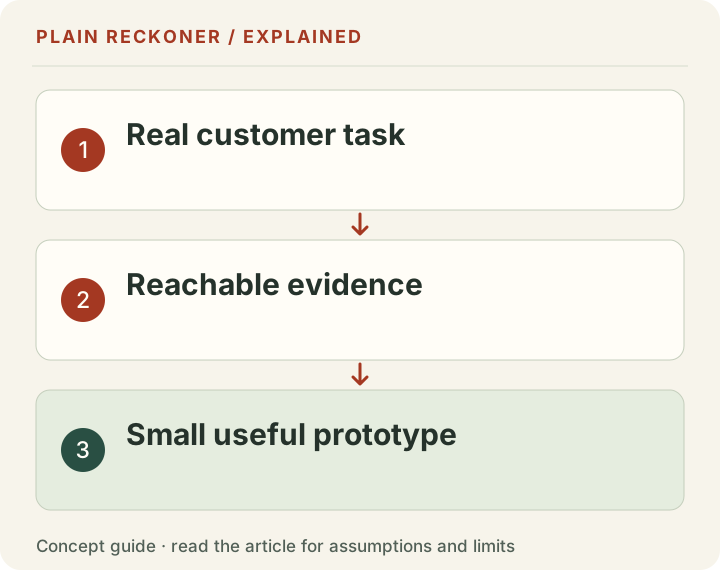
A prototype that helps one person is a reason to investigate further, not a finish line. Check whether others can use it, whether the explanation is clear and whether the costs remain manageable. Observe the whole task rather than only the first click.
If the evidence supports a narrower audience, refine the offer instead of claiming a broad market. If the source burden is too high, consider a smaller service or permissioned relationship. If users do not need the result, do not hide that finding behind more features.
The historical nine screens and three internal tools show how a project made decisions under its own conditions. Their strongest transferable lesson is procedural: connect an idea to a real task, inspect substitutes, test feasibility and preserve the evidence behind the next step.
You do not need to find an empty internet. You need to help someone do something worthwhile, explain the limits and learn whether the help works for the people you intend to serve.
Use a short review note before committing more time
Write six answers: who faces the problem, what decision they make, how they handle it now, what the prototype supplies, what evidence exists and what remains unknown. Keep each answer concrete enough that another team member could challenge it.
If the evidence field contains only search-result observations, the next step may be talking to likely users. If the need is documented but the source is uncertain, test collection and permission. If the prototype works but nobody can use it without help, investigate the interface.
This review avoids a false choice between endless planning and building blindly. It gives the next hour of work a question that can actually be answered. A useful result may be a narrower scope, a rejected assumption or a functioning first task rather than a dramatic claim that the market has been conquered.